
Milo and I recently visited Adelaide together for a big chess tournament. The last time we visited the City of Churches, just the two of us, Milo was only ten months old and he filled a Qantas cabin with couscous… if you like, you can read about it here.
In a tournament like this the kids play nine matches over the space of three days in a cavernous school gym, demonstrating more patience, resilience and sportsmanship than any assembled group of adults of a similar size could ever hope to muster.
But this is not the story of that chess tournament, we’ll get to that soon. This is the story of a Rainbow Lorikeet called Lucky, who literally fell out of the sky and landed on Milo’s shoulder.
Surprising ourselves, we arrived early on the first morning of the tournament, a Saturday, so had a few minutes to walk around before we had to register Milo to play. All of a sudden I heard a dull slapping noise behind me followed shortly thereafter by a yelp from Milo. “What is going on!!?” he yelled, genuine fear in his eyes as he ran towards me. Whilst hugging my leg he quickly explained he had been looking at a dead parrot on the ground when a second bird had literally thudded onto his shoulder before tumbling down onto the concrete.
A quick examination of the scene confirmed his story; a Rainbow Lorikeet quivered on the ground, looking most distressed indeed. And in fact there were not one but two other Lorikeets lying dead in the near vicinity. It was a curious and confronting scene.
Milo burst into tears and dashed to the injured bird, crying for me to help her. I immediately sprung into adult mode… which is to presume nothing can be done, briefly comfort the child, distract, and move forward.
“Oh buddy”, I said “she is really injured. It is so sad but I think there is nothing we can do for her.”
Milo was having none of it.
“But we have to try! She already has ants on her!” he wailed, tears streaming down his little cheeks. It was true, the ants had found her quickly and she was doing her best to keep them out of her eyes. She seemed somewhat paralysed and was not being particularly successful at defending herself.
I scooped her up in a smooth, curved piece of bark and lifted her off the ground, placing her on some soft clover in a garden bed.
“Well, that will at least get her away from the ants”, I said “and give her some peace.”
Good job, I thought. Great parenting. What else can we do?
“Alright”, I said “we’d better get you registered to play.”
It is amazing to me that even after nine years I am still capable of so thoroughly underestimating my child’s determination.
“I don’t care at all about chess,” he said firmly, tears drying a little on his cheeks “we are saving her.”
I sighed. Then looked at my watch.
“Alright.” I said “Let’s see what we can do.”
We had about 40 minutes until his first game and it was quite clear to me that he had no intention of playing if our new Lorikeet friend was not, by then, somewhere safer than a garden bed. I called WIRES (the NSW native wildlife rescue volunteers) and while on hold I took his hand and walked through the school to find the registration counter.
There was a long queue which gave me enough time to get to the end of the hold sequence and learn that WIRES only operates in NSW. It also gave me enough time to call the South Australian number that WIRES gave me and learn that due to ‘resource constraints’ their hotline is no longer monitored. Grab a cardboard box and find a vet that will take injured wildlife… if you can, was the only advice we received before the line disconnected.
I began to explain all of this to Milo but his eyes told me that we were getting a box and finding a vet, so my story trailed off. By now we were at the front of the queue. I registered Milo to play and then asked for a cardboard box because my son had been hit by a Lorikeet which had fallen from the sky.
The registration lady looked at me blankly and responded with only single word questions “Lorikeet? sky? box?”
“Yes please.” I said, and she shuffled off looking a little bemused. She returned moments later with a huge, flat box. The type you might transport a hundred mangoes in. Not ideal I thought, but it is definitely a box.
By now we were down to about 30 minutes so we quickly returned to where we had hidden the Lorikeet, dragging our huge box behind us.
The poor bird was still there and the ants had found her again. She flicked this way and that, trying to dissuade them, but she could barely move and it looked as if she had trouble moving her eyelids. I carefully scooped her up into the box and we both tried to brush off as many ants as we could. I searched for the nearest vet, which was mercifully only a kilometre or two away, and off we went on foot, with our tiny bird quivering in the corner of our giant cardboard box.
But after only 3 or 4 minutes the Lorikeet mustered whatever energy she had left and took to the air, soaring… and then very quickly landing again on a low branch across the street, perhaps 3 metres from ground level.
I adulted again.
“Fantastic, she can fly!” I said with contrived joy “she’s ok!”
Milo can muster an award winning, world-class scowl when he wants to. And he gave it all to me.
“Dad, she is definitely not ok. Look at her!”
He was right. Although her little talons were holding grimly to the branch, she was askew and appeared very precarious, wobbling back and forth. Her little eyes were mostly closed and she was shivering slightly.
“If we leave her now she will fall out onto the road and die.”
He was right, of course. He mostly is.
“Alright,” I responded meekly “what should we do?”
“Get her down. We have to get her to vet.” He looked up at the tree. “Climb up and get her.”
I too looked up at the tree and gulped. Ummm. It was potentially possible, but more likely would result in a broken ankle for me, and a whole lot of general life hassle. She was perched way out at the end of an increasingly skinny branch, which looked suitable for a tiny, hollow-boned Lorikeet, but definitely not suitable for a dense-boned, not-as-spritely-as-he-once-was, middle aged man.
“What else?” I asked.
“How about a long stick?” suggested Milo. A fine idea. “We could pile soft things in the box, place it under her and poke her out. She won’t like it but it will be worth it.” This kid is full of good ideas.
Milo quickly found a suitable stick while I positioned the box and lined it with my flannie and Milo’s hoodie. I stood on my tip-toes and started gently prodding the bird. Milo was right, she wasn’t pleased, but she couldn’t do much about it. She closed her eyes and just continued to cling onto that branch.
We tried different angles. We tried gently shaking the branch. We tried calling out to her. Nothing worked. She clung on and shivered and generally looked miserable.
As I poked, I looked up at the tree and once again started considering the very VERY poor idea of clambering up there. And then, just as I was about to give up, our little Lorikeet seemed to finally figure out we were trying to help her and hopped onto the end of our long stick, and clung on tight.
“She’s on!” we both yelped and I carefully lowered her down to the box. Once on she was not getting off, so I snapped off the end of the stick, gently covered her with my flannie, and we were off again in the direction of the vet. I didn’t want to look at my watch but I knew we were cutting things very fine.
We arrived at the vet flustered and a little out of breath.
“How can I help you?” asked the lady at the front desk “what have you got there?”
“Hi” I responded sweetly, holding the giant box out in front of me. “It’s a Rainbow Lorikeet. It fell out of the sky and landed on my son” I turned and pointed at my tear-streaked son as if to prove the story was true, at least the aspect related to the existence of a son.
Now, we had not looked under the flannie during our walk, and our Lorikeet friend had not looked well when we covered her up. So we were all, I think, preparing for a tiny, unmoving little bird when I removed my shirt. But to our great delight she popped her little head up and shook her feathers a little.
The receptionist did not take the box from me right away and, I think, briefly considered not taking this on as her problem. However, she quickly read the you have to take this bird from me in my eyes, smiled and took the box.
“I’ll transfer her into a cage” she said kindly, “and I’ll get the vet to take a look when she is free.”
I thanked her and then asked if we might be able to drop by or call later to get an update. She explained that their practice would close in 30 minutes and would not open again until Monday. But she took my number and smiled reassuringly at Milo. He smiled too, paused for a moment, and than seemed to accept there was nothing else we could do for now.
We declined the offer of taking the giant box away with us, and started walking back to the chess tournament, arriving with 2 or 3 minutes to spare.
Now, of course as soon as Milo had sat down at his board I called Kuepps (my wife and Milo’s mum) to tell her the whole story. She listened intently and then immediately said she had read an article about Lorikeet Paralysis Syndrome (LPS) which is affecting thousands of Rainbow Lorikeets in Queensland and Northern NSW (but not South Australia as far as anything we could find would indicate). She sent me a couple of articles and then we set about researching what we could.
Before Milo finished his first game I had found a professor at the University of Sydney who is leading a research project to better understand the cause of this syndrome, and to hopefully find a cure or remedy. The best working theory at present suggests the paralysis is caused by Lorikeets eating the fruit or seed of an introduced plant species. It is seasonal and only seems to occur in the summer months.
Milo bounded out of the hall.
“How did you go?” I asked.
“I lost,” he said quickly “how do you think our Lorikeet is?
“Well, I’ve got a lot to tell you,” I said “let’s get some lunch.”
We found a sandwich place and I filled him in on everything Kuepps had told me, and everything I had found in my googling, including the professor’s work at the University of Sydney. I explained that it seems most birds die from dehydration, starvation or predation from ants, birds or mammals. But, if they are found quickly enough, and cared for, they can survive.
Milo beamed and then his mechanical brain clicked into action.
…oh my goodness… this could be an important scientific discovery… if this is the first case discovered in South Australia that is really significant… we could save thousands of birds… okay, when was the first article written… 2021? …okay we need to figure out what species have been introduced since 2021… oh, what is the likely radius the birds would fly before they fall out of the sky… okay… figure out that radius… then write down all the introduced species in that radius… then I guess we have to remove all those plants from the whole country…
You could see the power and possibility of scientific research surging and pulsing through his brain. It was palpable.
“We have to email the professor and tell him what we found!”
So we did. We found his Sydney University email address and drafted a long email over lunch, telling him everything. We also decided our Lorikeet’s name would now be ‘Lucky’.
Milo won his second match (at least in part because he distracted his opponent by regaling him with the tale of Lucky), lost his third and we headed out for burgers and a movie. Lucky was never far from Milo’s thoughts however; a new idea or question popping up periodically throughout the evening.
To our delight and surprise, the following morning brought a reply from the professor, on a Sunday! Milo was most chuffed indeed. Thank you Milo for the information, it is interesting, I have forwarded to my colleague at Adelaide University, I will email the vet, I have copied in my research assistant and good luck for the chess today! Well, for Milo’s scientifically curious mind this was about the most exciting development possible. We called Kuepps and Monty and told them everything, and Milo then proceeded to win two of his three games that day.
On our way home we noticed one of the dead birds was not a Rainbow Lorikeet, but some other kind of parrot. All the articles we had read only mentioned Rainbow Lorikeets so we thought the prospect of the paralysis impacting other types of parrots might be significant. So we took a photo and then carefully moved the dead parrot onto some bark and under a bush to keep it somewhat protected, in case the Adelaide University colleague might want to collect it. We sent our discovery to the professor.
The next morning brought another reply! Yes, this was interesting, the bird is a Musk Lorikeet, common in South Australia, thanks again and I have forwarded the information to Adelaide University.
It was Monday, the last day of the tournament, and our last opportunity to learn what we could of Lucky’s fate. We were flying home later that evening.
Milo lost his first game of the day and afterwards I asked him whether he wanted to go to the vet now, or after his third game. I said I would let him choose but noted if Lucky had died it would very likely impact his ability to play the last two games.
Milo thought about it for a moment and said he would like to go now. Yes, he agreed it would make it hard to play his last two games, and he would probably lose, but he would prefer to find out what had happened to Lucky.
So we walked to the vet, hoping for good news but also trying (probably in vain) to manage our expectations. When we arrived the receptionist was different to the lady from Saturday. He was a smiley young man who asked how we could help.
Milo and I gave him the full story, babbling over each other, including the paralysis syndrome and the professor, and the email he may have received, and the Musk Lorikeet, everything. He looked blankly at us, advised he had not worked on Saturday and that the practice was closed on Sunday.
He stood up and did that thing where you push papers around, open and close browsers on your computer and say things like “I’m not seeing any notes here. Hmm. No, nothing. Nope, no notes…” open a drawer, close the drawer, look around a bit… hoping the other person will say something like “oh that’s okay, no worries, thanks for trying”. We said none of those things and just kept silently staring at him. I was smiling. Milo’s face was morphing slowly from smile to scowl.
“Would you like me to call the receptionist from Saturday?” he offered, somewhat hopelessly.
“Yes, thank you that would be great!” I replied.
He smiled grimly, picked up his phone and walked into another room, presumably in case the response was “Oh the Lorikeet? It died and I hoiked it in the bio-hazard bin.”
To our delight (and his), the receptionist returned with a smile on his face and proudly announced that on Saturday the Lorikeet had been transferred to another vet nearby, because their practice would be closed.
Believing our matter was now concluded the receptionist smiled again and turned his attention to the slowly growing queue behind us. But we remained.
“Would you mind calling the other vet to find out if she is okay?” I asked.
“The other vet? Call them? Me? Now?” we nodded.
“Of course, one second” he said very graciously and then once again retreated to his private room reserved for private conversations about unfortunately dead Lorikeets and their disposal.
But once again he returned triumphant, a broad grin on his face, and announced that the Lorikeet had grown stronger over the weekend and had yesterday been handed to a wildlife carer before (hopefully) being released back into the wild when she is strong enough.
Well, this was most excellent news indeed. Milo and I squeezed hands and grinned at each other.
The receptionist, now very sure our business was concluded, turned his attention to the next customer. But we were still there.
“Could we please have the address for the other vet?” I asked.
“The other vet?” he repeated.
“Yes please,” I said “we’d like to go and see if we can find out anything more.”
“Of course” he said kindly, handed us the address, and off we went, still on the trail of Lucky but now very much buoyed by the news that possibly, in fact probably, she had been saved.
It was another 1 or 2 kilometres to the second vet and we arrived even hotter and even more out of breath than before. Essentially copy and paste the above interaction with the receptionist at the next clinic, but also add four interruptions from dogs being dropped off (and patted by Milo), so the story became rather elongated and disjointed. The receptionist consulted with the vet who had cared for Lucky on Sunday and confirmed the story we had heard – she was much better by Sunday evening and had been transferred to a wildlife volunteer for specialist care before she can (hopefully) be released into the wild.
Ultimately I asked whether we could know where the carer lived so perhaps we could see Lucky before we departed Adelaide that evening. Quite reasonably the receptionist said she could not do this for privacy reasons but she agreed to take my number and pass it to the carer in case she was happy for us to visit.
We never received a call from the carer, so we will never see Lucky again. But we updated the professor and both felt so pleased with the outcome, and the effort we had gone to. Milo, despite obvious exhaustion, managed to win his last two games of the tournament and we left Adelaide tired but energized; Milo with a renewed zeal for science, research and wildlife preservation.
It is common as a parent to say proudly to one’s self (or others who will listen) “having children has made me a better person”. This is usually very nebulous – like, since I’ve had children I am far less likely to eat a kebab while sitting in the gutter at 2am, or I am now aware of pin worms and how to deal with them.
But on this occasion it was very specific and very tangible. Without Milo I would have done none of those things. I would have convinced myself there was nothing I could do, justified it to myself, walked away and in pretty short time forgotten all about it. Lucky would have been eaten by ants, or a cat, or a larger bird. We never would have emailed the professor and Milo’s potential ‘scientific discovery’ would not be recorded.
Children are beguiling and challenging and regularly beseech us to follow them down paths we don’t want to take. Often it is simply not possible to take those paths, for all sorts of very valid reasons. We explain those reasons all the time to Milo and Monty, then pull them in behind us onto our path, and we all walk on together. But more often than we would like to admit, it is possible to take a moment, follow them a little way, and maybe a little further, and see where it takes us…
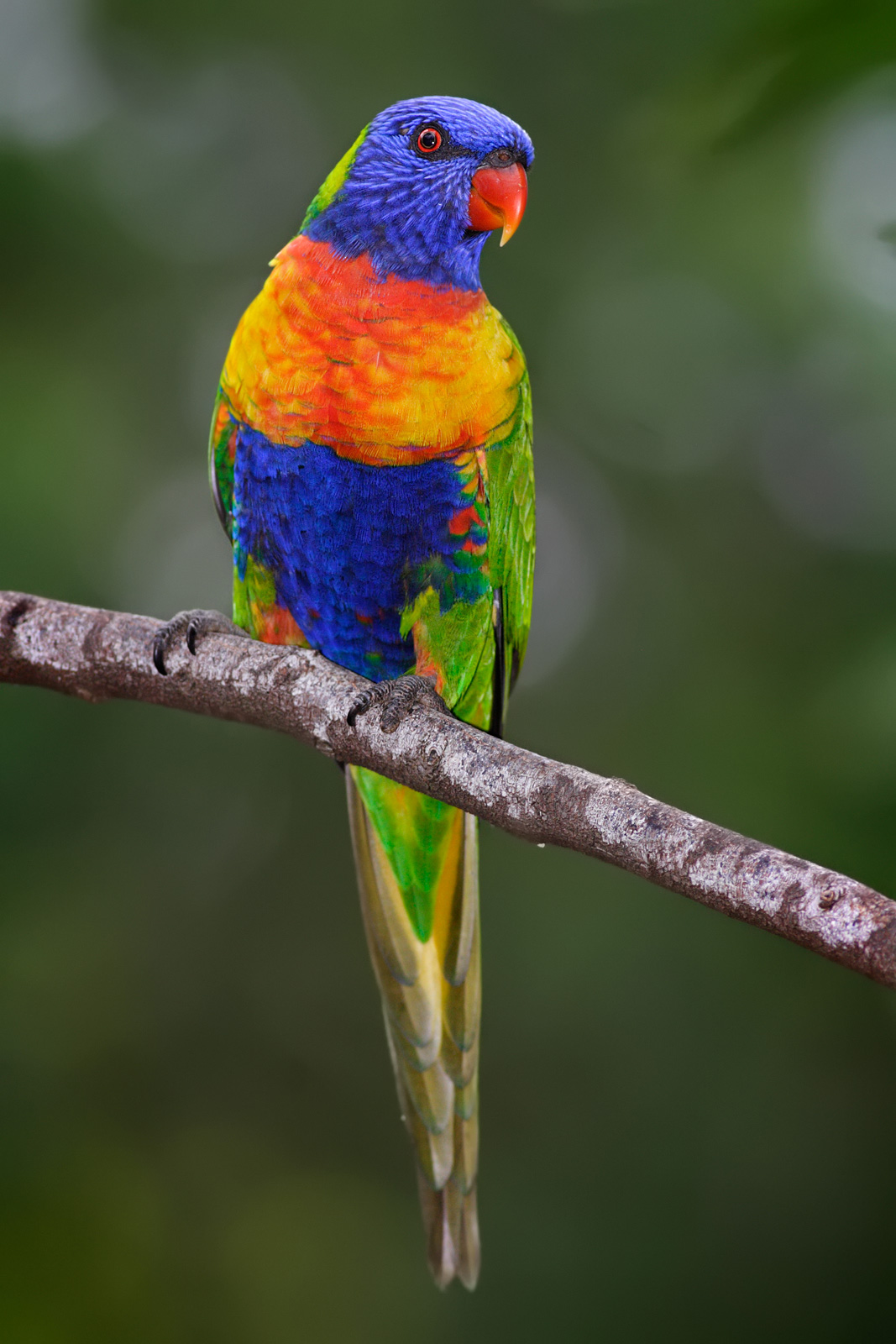
A Rainbow Lorikeet unafflicted by Lorikeet Paralysis Syndrome
 Jupiter & Sons
Love this! Go Milo. (And Lucky)
LikeLiked by 1 person
Beautifully written mate! I feel like Milo and our eldest have a lot in common when it comes to empathy for animals!
LikeLiked by 1 person