
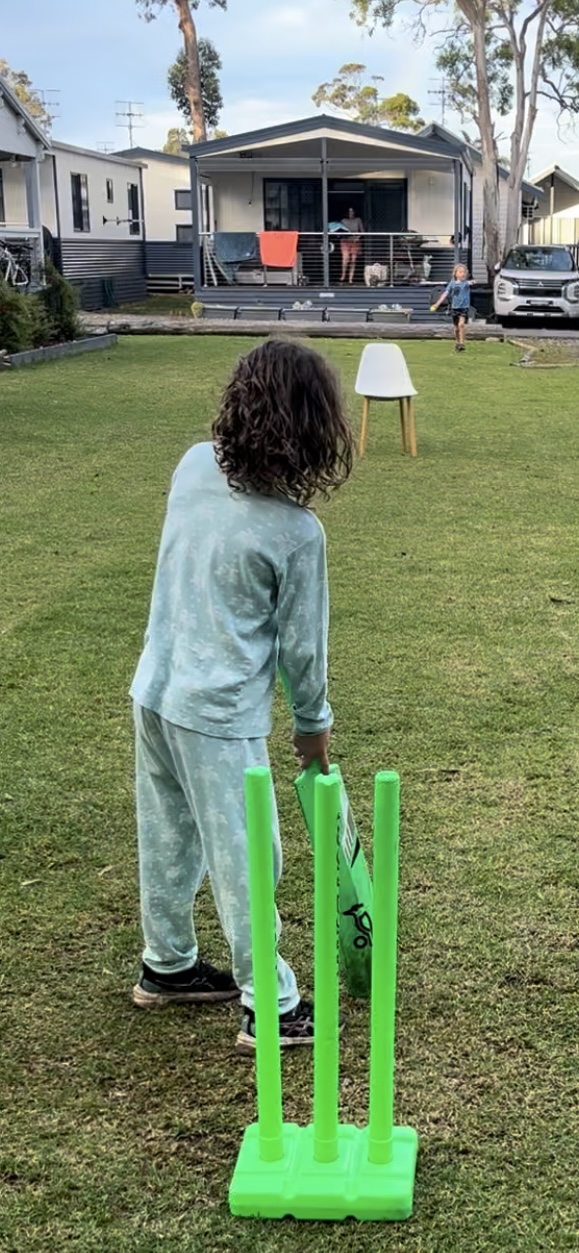
For most Australian kids, even bookish chess-oriented ones, backyard cricket in the summer is a wonderful experience. And so it was for Milo this past summer. For weeks we played every evening with the cousins. Lots of bowling, lots of swashbuckling, care-free batting, lenient umpire-uncles, a little bit of fielding, usually a zooper-dooper appears or a sausage on a piece of bread. Heaven.
The warm cricket experience carried through to our return home, and the start of a new school year. We played in the driveway until late in the evening, and when the days got shorter we installed a flood light which made it wonderful to bat, but impossible to bowl. I could even see Milo starting to modify his game to suit the conditions, as all backyard (or driveway) cricketers do; gallant over the offside to the short boundary on the other side of the cul-de-sac, but cautious off his pads to the shorter boundary with the tall pointy fence and the dog on the other side.
One evening, as I walked in my crocs once more across the road to fetch one of my dispatched pies, Milo asked me “could I play for a team in Darwin?”. I was surprised, pleased at his interest in trying something new, but simultaneously apprehensive because actual cricket is pretty shit to play, not very sun-smart and really very shit to be administratively associated with in any way. But I answered as any semi-decent parent would; “I’ll google it”.
And so before long Milo had received some long nylon trousers and matching long-sleeved shirt, perfect for the tropics, a floppy hat, and in a mystery that I am sure will remain unsolved, I found myself on a team whatsapp group stocked with parents and administrative types.
After early introductions the club manager got right to the point, requesting volunteers for a coach and a team manager. Well, there her message sat, unashamed, unyielding, but also unanswered, for at least 36 hours, until I couldn’t take it anymore. I sent a private message to just the club manager saying I don’t know much about cricket and couldn’t commit to being a coach, but I would be happy to take on the noble burden of team manager, whatever that is. Within moments she had responded to the full group congratulating me on my appointment as co-coach.
Well played, I thought, and immediately ordered ‘Cricket Coaching for Dummies’ on Amazon.
So Milo and I arrived at his first training session, a balmy Monday evening, feeling bewildered and unsure about our recent choices. As we walked over to a group of adults who looked like they knew slightly more than me, I whispered to Milo that I was feeling as nervous as he was. He seemed to like that.
We followed their semi-instructions and soon found ourselves at one end of the nets, surrounded by small cricket enthusiasts, with balls pinging this way and that. A smiling other-parent introduced himself as the coach and said he was glad to have me with him this season. I think he believed me when I offered similar salutations and words of enthusiasm for what lay ahead.
Now, a ‘net session’, as it is known in cricketing circles, essentially entails one person putting cricket-armour on and the other 6 or 7 people (or whatever it is) taking it in turns to hurl cricket balls at you. When the batter is bored, or bruised or belittled sufficiently, they waddle back out of the net, take off their armour and commence hurling cricket balls at the next person. Milo had never seen a ‘net session’ before, and he didn’t much like the look of it.
He looked at me with those half-closed, suspicious eyes that he is fond of deploying and said; “do I have to put that stuff on?” Now, I know my child. Most kids facing this situation for the first time might be concerned about the isolation of it, or the potential to be hit in the many soft areas of the body that the armour neglects, or simply the daunting challenge of facing so many new ball hurlers he had never met before. I knew immediately what was on his mind. Sweat. And more specifically, other people’s sweat.
“Yup. But what you need to do is put your hand up to bat next and the gear will still be fresh and sweat free.”
His withering look remained; “but that girl is already wearing it.”
“Yes, true. But there is usually 2 or 3 sets in the kit and most of these kids will have their own. Go and tell the proper coach you want to bat next.”
So he did, and he did! And he batted pretty well. Although some of the older kids were quite brisk, nothing like Uncle David’s loopy left armers that are supposed to turn out of the rough but never do. Most importantly he avoided soft tissue damage… and sweaty gloves.
This luke-warm training session did, I must admit, make me somewhat nervous about our first match, which took place three days later. I was right to be nervous.
The 0730 arrival time did not please him, nor did the heavy, flammable uniform. The floppy hat was ruled out immediately. But it wasn’t until he learned that the game would take three hours, and that for most of that time he would be doing nothing but stand around in the hot sun with insects buzzing around him that he really started warming up his scowl.
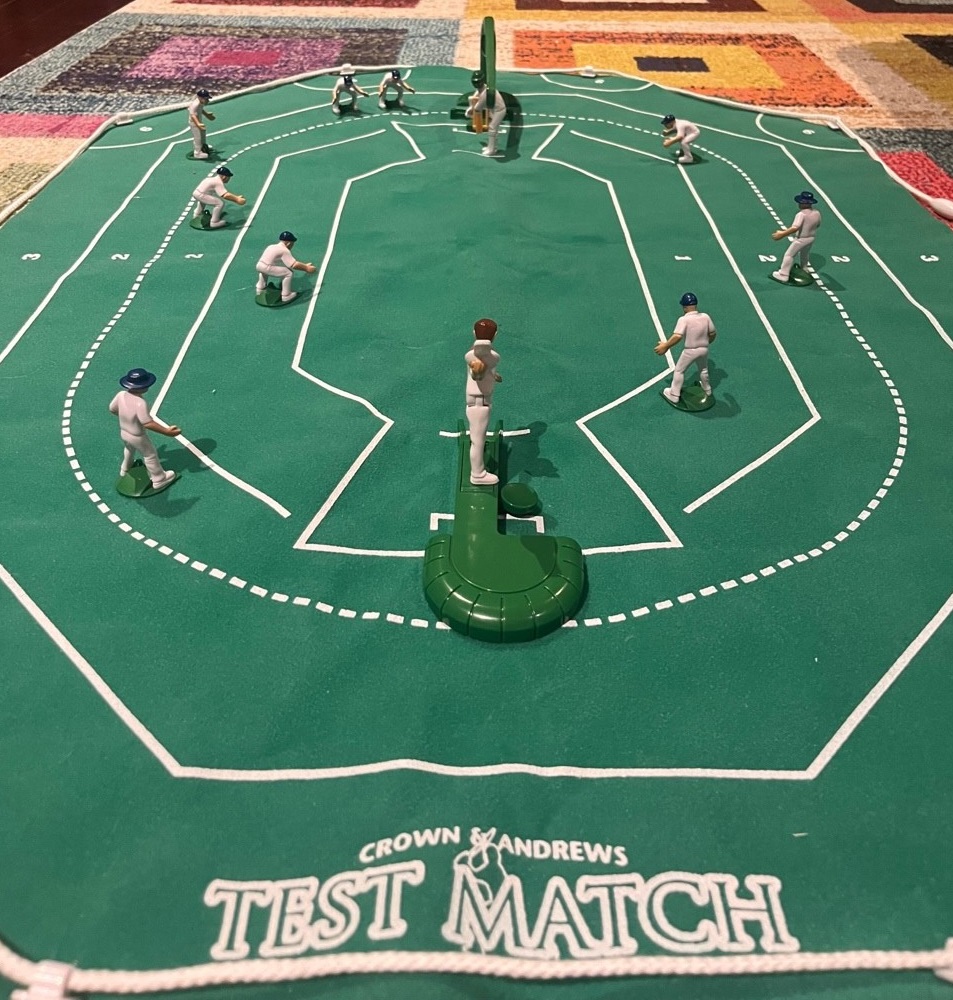
Fielding first also didn’t help. In Milo’s age group the field basically cycles like a merry-go-round. After each over the fielders move around one position, clockwise, until they arrive at the bowling end, have a bowl and then keep rotating. So, for the first over Milo sat down at point, where everybody yelled at him to stand up. During the second over he sat down at gully, at which time everybody yelled at him to stand up. Then backstop where he sort of lay down and nobody said anything to him, and then around to square leg where he squatted and then kind of rolled down onto his forehead. He was quite excited to discover that his team had too many players so after square leg he rotated off the field for an over.
He ran off the field and straight over to me where I was sitting in the shade trying to figure out how to score the game with a very confusing iPad app. He arrived, looked wordlessly at me for a moment, shook his head as if to say WTF is this? then asked me for his book. I handed it over and he walked off to sit in the grass next to the boundary and commenced reading.
Milo’s one over respite was over quickly but when the next player came to take his place he waved them off and kept reading. They were very pleased to rotate around to mid-wicket and so did not argue.
This was not going well.
After one more over the real-coach realised what was happening and beckoned Milo back onto the field. He complied, but took his book with him. The real-coach advised him that wasn’t a great idea because he might be hit with a ball if he read at mid-wicket. Milo thought about this for a moment, placed his book on the ground and walked slowly, very slowly, to mid-on. Later on he had a bit of a bowl which was okay, and then recommenced cycling around the field, sometimes sitting, often distracted and always displeased.
The great thing about cricket is, once you are done standing around (or sitting) inside the field not doing much for an hour or two, you then get to stand around (or sit) outside the field not doing much for an hour or two. Milo wasn’t sure whether to be confused, disgruntled or enraged. He settled on disgruntled and loudly advised the real-coach he wasn’t going to bat. The real-coach did a very nice job of coaxing and encouraging Milo who remained unmoved on the issue for the best part of 15 overs until his cousin convinced him to ‘pad up’, as they say, and waddle out to the middle; no mean feat, and a fine demonstration of the true power that cousins possess over each other.
So he batted, was non-plussed by the whole thing, ate some grapes, received a Happy Meal voucher for ‘player of the game’ (again the real-coach did absolutely everything he could to enamour Milo) said goodbye and we drove home.
Of course on the drive Milo said he never wanted to play again, and he seemed more baffled than anything by the whole experience. I chose not to play my hand while Milo still had other people’s helmet sweat on his brow, but later in the week I picked my moment to tell him that he would need to ‘give cricket a proper go’ before he could quit ‘to make sure he was making the right decision’. Two games and two trainings was the arbitrary number I came up with. Why? Why is two the right number?
I must have caught him off guard because he agreed, and the following Monday we found ourselves back at the nets. Once again he didn’t bat and patted dogs for most of the session, and on the way home he said he didn’t want to play two more games or in fact any more games of cricket. Ever.
Trying my best to parent, I explained calmly that he had made a commitment and that he ‘owed it to himself and his teammates’ to give it a proper try. Unsurprisingly this approach was not well received but I shut the conversation down, not wanting to have the final showdown so early in the week.
Before I get to the last part of this story, I think it important to reflect on the fact that he doesn’t want to play cricket and nor do we want him to play cricket. Cricket is an odd, slow, boring sport that, if allowed to develop unchecked, will consume our weekends and then our lives, and then give our child basal-cell carcinomas in his 30s.
And yet…
I chose Friday evening to remind him that the following morning he and I would be going to cricket. He was playing Nintendo and, although he did not look up and arguably thought I asked him if he wanted a slice of toast, replied ‘ok’. I took this as a small win. It was not.
Saturday morning I woke Milo just after 0700 and reminded him of his solemn commitment to the cricket Gods, and finally it all unraveled. Once in full flight Milo is something to behold and he and I were flying high together.
There were pink faces and clenched fists and squinty eyes and lofty statements from me and tears and mucous… and finally, I slammed the door and drove by myself, to umpire a game of junior cricket in which my child was not playing, for three hours, without enough water.
I arrived home around lunchtime and we were both feeling far more relaxed about the whole thing. He asked me, with a slight grin, “what are you going to do now dad?” I explained that I had made a commitment to the team so I would continue pseudo-coaching for the rest of the season which is about 10 weeks, I guess to demonstrate good behaviours to my children?
So now, each Saturday morning I fill my giant Yeti water bottle, apply sunscreen, wave goodbye to my family at around 0720, and head off to some patch of grass somewhere or other to stand around not being all that useful to anybody. My family, comfortable in their pyjamas, look up from their breakfast, wave back and wish me luck. And just to demonstrate how ludicrous this situation has become, this week Kuepps was interstate so we paid a babysitter $125 to look after the boys for the morning, which is more than the cost of the entire season’s registration.
So here’s the thing; when I look back at all the individual decisions that led us up to this point, they all seem quite reasonable. And yet, the sum of those many reasonable decisions is well, quite unreasonable, and I haven’t even been on orange and grape duty yet.
Sometimes it does get tiring to be so constantly reminded how much we still have to learn about parenting.


 Jupiter & Sons