Bob the Prawn debuts amidst chaos

Bob the Prawn debuts amidst chaos

Avid readers of this blog, or even those with a tangential interest via a partner who forwards it to you sometimes even though you don’t care at all, may recall that in late 2023 Kevin the Flamingo was tired, rung-out and suffering from at least one slow leak.

Mercifully, Kevin was placed in the ‘shrink wrap for the wet season’ pile over the summer holiday and an internet search was begun in earnest to find a replacement. It was remarkable to me how much comes back in one’s search engine when one types ‘inflatable ride-on costume’. Try it. It yields a pleasingly large selection. So large in fact that we needed to short list and then vote on Kevin’s replacement, via an anonymous preferential ballot.

The short list was:

  • rainbow unicorn
  • avocado guy
  • super pizza man
  • ride on chicken
  • ride on snail
  • ride on prawn
  • Shiba Inu

It was a tight ballot actually, with avocado guy exceeding early pre-polling expectations, but ultimately ride on prawn won the day. So we paid our $49.99 and way sooner than you might expect it would take to receive a ride-on inflatable prawn from China, he had arrived on our doorstep. We named him Bob.

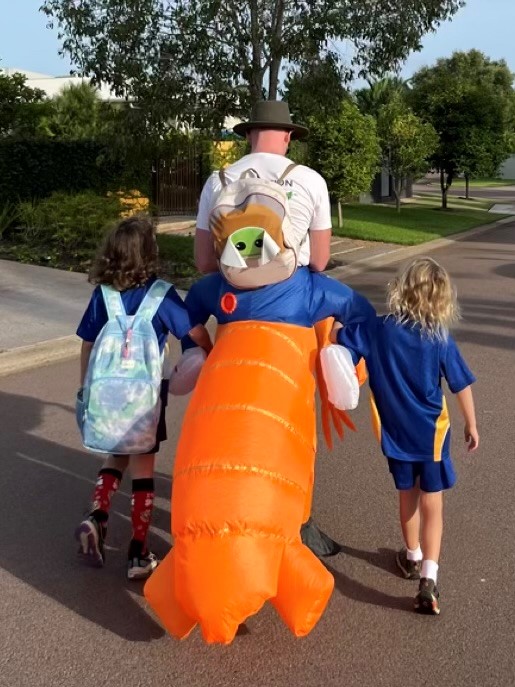
Our first impression of Bob was that he was waaay bigger than we expected. He is at least 2 metres end to end, and has a giant protruding fluorescent booty that juts out and then droops grotesquely under its own weight, dragging on the ground. He has creepy little feelers that dangle out all over the place but also cute little blow-up eyes that do somewhat redeem the whole thing. Same as Kevin, Bob has tiny little blow up child-sized legs that are supposed to provide the illusion that I am riding him. But my torso is way too big so it all looks rather confusing and odd. Still, the boys’ objective remains memorable stupidity, and Bob delivers.

This week marked a return to school after a very long summer break. Morning one (Tuesday) brought with it a ferocious monsoonal downpour. This is not an inconvenient drizzle that causes you to hold a magazine over your head while you accelerate slightly from your car to the front door of the cafe, hopping once or twice awkwardly like a gazelle over developing puddles. No, this is like there are families of mischievous possums on your roof dumping buckets of water on you as soon as you exit your front door while others from the same family, who are hiding in the bushes, whip you viciously in the face with palm fronds.

Hmmm.. we thought, as I pulled Bob awkwardly up over my legs, and we peered out through our foggy windows at the aquatic carnage beyond.

“I still want to walk” exclaimed Milo, “we’ll take umbrellas”. Fair enough.

Monty did not express an opinion because Monty was still asleep. This was, as it turns out, not good.

Monty awoke eight minutes before our scheduled departure, took one look at the squall, and declared he was not going to school. Perhaps not ever again. Parents can generally tell when a child is trying it on, reasonably serious or absolutely committed. Monty was absolutely, positively, definitively committed to his course of action, which surprised us because he is not ordinarily that committed to anything… except terrariums.

It was rather quickly apparent that there was to be no negotiation. Not even the desperate and reckless offer of a Crunchie Bar before breakfast made any impact. Nope, this was to be a forced relocation.

So, dressed in aforementioned enormous prawn suit, I scooped Monty out of bed and hoisted him, kicking, screaming and clawing into the air while Kuepps dressed him. I then carried him out into the wild weather and plopped him into the car. The hastily, and not particularly well conceived plan was for Monty and Kuepps to drive really slowly next to Milo and I while we walked the 10 or so minutes to school.

Milo could not have been happier. Torrents of water tumbled down the overflowing gutters, he was using his umbrella to collect water, not shield himself from it, and he was splashing from deep puddle to deeper puddle. My feeble attempts to dissuade this behaviour were fruitless. I had the agility, speed and influence of, well, a giant inflatable prawn. I was helpless.

So by the time we arrived at school Milo was beaming with joy but absolutely, absolutely drenched. Kuepps opened Monty’s door and he was still bellowing at the same volume as if no time had passed at all. It reminded me of that scene from Ace Ventura where he stands on the balcony yelling in a very Jim Carrey way as he opens and closes the ‘double-paned sound proof’ sliding door. Noisy, not noisy, noisy.

So, I scooped him up again, pinching and grappling, and we waddled with as much haste as possible across the street to their school, Milo trying his best to keep Bob’s tail out of puddles.

Ultimately we managed to deposit both children into their respective classrooms (with spare clothes in their bags and smiles of relief on our faces) and escape the school grounds relatively unscathed.

Welcome Bob. Memorable stupidity… check.

Bob on a brighter day

Lucky the Lorikeet falls from the sky

Lucky the Lorikeet falls from the sky

Milo and I recently visited Adelaide together for a big chess tournament. The last time we visited the City of Churches, just the two of us, Milo was only ten months old and he filled a Qantas cabin with couscous… if you like, you can read about it here.

In a tournament like this the kids play nine matches over the space of three days in a cavernous school gym, demonstrating more patience, resilience and sportsmanship than any assembled group of adults of a similar size could ever hope to muster.

But this is not the story of that chess tournament, we’ll get to that soon. This is the story of a Rainbow Lorikeet called Lucky, who literally fell out of the sky and landed on Milo’s shoulder.

Surprising ourselves, we arrived early on the first morning of the tournament, a Saturday, so had a few minutes to walk around before we had to register Milo to play. All of a sudden I heard a dull slapping noise behind me followed shortly thereafter by a yelp from Milo. “What is going on!!?” he yelled, genuine fear in his eyes as he ran towards me. Whilst hugging my leg he quickly explained he had been looking at a dead parrot on the ground when a second bird had literally thudded onto his shoulder before tumbling down onto the concrete.

A quick examination of the scene confirmed his story; a Rainbow Lorikeet quivered on the ground, looking most distressed indeed. And in fact there were not one but two other Lorikeets lying dead in the near vicinity. It was a curious and confronting scene.

Milo burst into tears and dashed to the injured bird, crying for me to help her. I immediately sprung into adult mode… which is to presume nothing can be done, briefly comfort the child, distract, and move forward.

“Oh buddy”, I said “she is really injured. It is so sad but I think there is nothing we can do for her.”

Milo was having none of it.

“But we have to try! She already has ants on her!” he wailed, tears streaming down his little cheeks. It was true, the ants had found her quickly and she was doing her best to keep them out of her eyes. She seemed somewhat paralysed and was not being particularly successful at defending herself.

I scooped her up in a smooth, curved piece of bark and lifted her off the ground, placing her on some soft clover in a garden bed.

“Well, that will at least get her away from the ants”, I said “and give her some peace.”

Good job, I thought. Great parenting. What else can we do?

“Alright”, I said “we’d better get you registered to play.”

It is amazing to me that even after nine years I am still capable of so thoroughly underestimating my child’s determination.

“I don’t care at all about chess,” he said firmly, tears drying a little on his cheeks “we are saving her.”

I sighed. Then looked at my watch.

“Alright.” I said “Let’s see what we can do.”

We had about 40 minutes until his first game and it was quite clear to me that he had no intention of playing if our new Lorikeet friend was not, by then, somewhere safer than a garden bed. I called WIRES (the NSW native wildlife rescue volunteers) and while on hold I took his hand and walked through the school to find the registration counter.

There was a long queue which gave me enough time to get to the end of the hold sequence and learn that WIRES only operates in NSW. It also gave me enough time to call the South Australian number that WIRES gave me and learn that due to ‘resource constraints’ their hotline is no longer monitored. Grab a cardboard box and find a vet that will take injured wildlife… if you can, was the only advice we received before the line disconnected.

I began to explain all of this to Milo but his eyes told me that we were getting a box and finding a vet, so my story trailed off. By now we were at the front of the queue. I registered Milo to play and then asked for a cardboard box because my son had been hit by a Lorikeet which had fallen from the sky.

The registration lady looked at me blankly and responded with only single word questions “Lorikeet? sky? box?”

“Yes please.” I said, and she shuffled off looking a little bemused. She returned moments later with a huge, flat box. The type you might transport a hundred mangoes in. Not ideal I thought, but it is definitely a box.

By now we were down to about 30 minutes so we quickly returned to where we had hidden the Lorikeet, dragging our huge box behind us.

The poor bird was still there and the ants had found her again. She flicked this way and that, trying to dissuade them, but she could barely move and it looked as if she had trouble moving her eyelids. I carefully scooped her up into the box and we both tried to brush off as many ants as we could. I searched for the nearest vet, which was mercifully only a kilometre or two away, and off we went on foot, with our tiny bird quivering in the corner of our giant cardboard box.

But after only 3 or 4 minutes the Lorikeet mustered whatever energy she had left and took to the air, soaring… and then very quickly landing again on a low branch across the street, perhaps 3 metres from ground level.

I adulted again.

“Fantastic, she can fly!” I said with contrived joy “she’s ok!”

Milo can muster an award winning, world-class scowl when he wants to. And he gave it all to me.

“Dad, she is definitely not ok. Look at her!”

He was right. Although her little talons were holding grimly to the branch, she was askew and appeared very precarious, wobbling back and forth. Her little eyes were mostly closed and she was shivering slightly.

“If we leave her now she will fall out onto the road and die.”

He was right, of course. He mostly is.

“Alright,” I responded meekly “what should we do?”

“Get her down. We have to get her to vet.” He looked up at the tree. “Climb up and get her.”

I too looked up at the tree and gulped. Ummm. It was potentially possible, but more likely would result in a broken ankle for me, and a whole lot of general life hassle. She was perched way out at the end of an increasingly skinny branch, which looked suitable for a tiny, hollow-boned Lorikeet, but definitely not suitable for a dense-boned, not-as-spritely-as-he-once-was, middle aged man.

“What else?” I asked.

“How about a long stick?” suggested Milo. A fine idea. “We could pile soft things in the box, place it under her and poke her out. She won’t like it but it will be worth it.” This kid is full of good ideas.

Milo quickly found a suitable stick while I positioned the box and lined it with my flannie and Milo’s hoodie. I stood on my tip-toes and started gently prodding the bird. Milo was right, she wasn’t pleased, but she couldn’t do much about it. She closed her eyes and just continued to cling onto that branch.

We tried different angles. We tried gently shaking the branch. We tried calling out to her. Nothing worked. She clung on and shivered and generally looked miserable.

As I poked, I looked up at the tree and once again started considering the very VERY poor idea of clambering up there. And then, just as I was about to give up, our little Lorikeet seemed to finally figure out we were trying to help her and hopped onto the end of our long stick, and clung on tight.

“She’s on!” we both yelped and I carefully lowered her down to the box. Once on she was not getting off, so I snapped off the end of the stick, gently covered her with my flannie, and we were off again in the direction of the vet. I didn’t want to look at my watch but I knew we were cutting things very fine.

We arrived at the vet flustered and a little out of breath.

“How can I help you?” asked the lady at the front desk “what have you got there?”

“Hi” I responded sweetly, holding the giant box out in front of me. “It’s a Rainbow Lorikeet. It fell out of the sky and landed on my son” I turned and pointed at my tear-streaked son as if to prove the story was true, at least the aspect related to the existence of a son.

Now, we had not looked under the flannie during our walk, and our Lorikeet friend had not looked well when we covered her up. So we were all, I think, preparing for a tiny, unmoving little bird when I removed my shirt. But to our great delight she popped her little head up and shook her feathers a little.

The receptionist did not take the box from me right away and, I think, briefly considered not taking this on as her problem. However, she quickly read the you have to take this bird from me in my eyes, smiled and took the box.

“I’ll transfer her into a cage” she said kindly, “and I’ll get the vet to take a look when she is free.”

I thanked her and then asked if we might be able to drop by or call later to get an update. She explained that their practice would close in 30 minutes and would not open again until Monday. But she took my number and smiled reassuringly at Milo. He smiled too, paused for a moment, and than seemed to accept there was nothing else we could do for now.

We declined the offer of taking the giant box away with us, and started walking back to the chess tournament, arriving with 2 or 3 minutes to spare.

Now, of course as soon as Milo had sat down at his board I called Kuepps (my wife and Milo’s mum) to tell her the whole story. She listened intently and then immediately said she had read an article about Lorikeet Paralysis Syndrome (LPS) which is affecting thousands of Rainbow Lorikeets in Queensland and Northern NSW (but not South Australia as far as anything we could find would indicate). She sent me a couple of articles and then we set about researching what we could.

Before Milo finished his first game I had found a professor at the University of Sydney who is leading a research project to better understand the cause of this syndrome, and to hopefully find a cure or remedy. The best working theory at present suggests the paralysis is caused by Lorikeets eating the fruit or seed of an introduced plant species. It is seasonal and only seems to occur in the summer months.

Milo bounded out of the hall.

“How did you go?” I asked.

“I lost,” he said quickly “how do you think our Lorikeet is?

“Well, I’ve got a lot to tell you,” I said “let’s get some lunch.”

We found a sandwich place and I filled him in on everything Kuepps had told me, and everything I had found in my googling, including the professor’s work at the University of Sydney. I explained that it seems most birds die from dehydration, starvation or predation from ants, birds or mammals. But, if they are found quickly enough, and cared for, they can survive.

Milo beamed and then his mechanical brain clicked into action.

…oh my goodness… this could be an important scientific discovery… if this is the first case discovered in South Australia that is really significant… we could save thousands of birds… okay, when was the first article written… 2021? …okay we need to figure out what species have been introduced since 2021… oh, what is the likely radius the birds would fly before they fall out of the sky… okay… figure out that radius… then write down all the introduced species in that radius… then I guess we have to remove all those plants from the whole country…

You could see the power and possibility of scientific research surging and pulsing through his brain. It was palpable.

“We have to email the professor and tell him what we found!”

So we did. We found his Sydney University email address and drafted a long email over lunch, telling him everything. We also decided our Lorikeet’s name would now be ‘Lucky’.

Milo won his second match (at least in part because he distracted his opponent by regaling him with the tale of Lucky), lost his third and we headed out for burgers and a movie. Lucky was never far from Milo’s thoughts however; a new idea or question popping up periodically throughout the evening.

To our delight and surprise, the following morning brought a reply from the professor, on a Sunday! Milo was most chuffed indeed. Thank you Milo for the information, it is interesting, I have forwarded to my colleague at Adelaide University, I will email the vet, I have copied in my research assistant and good luck for the chess today! Well, for Milo’s scientifically curious mind this was about the most exciting development possible. We called Kuepps and Monty and told them everything, and Milo then proceeded to win two of his three games that day.

On our way home we noticed one of the dead birds was not a Rainbow Lorikeet, but some other kind of parrot. All the articles we had read only mentioned Rainbow Lorikeets so we thought the prospect of the paralysis impacting other types of parrots might be significant. So we took a photo and then carefully moved the dead parrot onto some bark and under a bush to keep it somewhat protected, in case the Adelaide University colleague might want to collect it. We sent our discovery to the professor.

The next morning brought another reply! Yes, this was interesting, the bird is a Musk Lorikeet, common in South Australia, thanks again and I have forwarded the information to Adelaide University.

It was Monday, the last day of the tournament, and our last opportunity to learn what we could of Lucky’s fate. We were flying home later that evening.

Milo lost his first game of the day and afterwards I asked him whether he wanted to go to the vet now, or after his third game. I said I would let him choose but noted if Lucky had died it would very likely impact his ability to play the last two games.

Milo thought about it for a moment and said he would like to go now. Yes, he agreed it would make it hard to play his last two games, and he would probably lose, but he would prefer to find out what had happened to Lucky.

So we walked to the vet, hoping for good news but also trying (probably in vain) to manage our expectations. When we arrived the receptionist was different to the lady from Saturday. He was a smiley young man who asked how we could help.

Milo and I gave him the full story, babbling over each other, including the paralysis syndrome and the professor, and the email he may have received, and the Musk Lorikeet, everything. He looked blankly at us, advised he had not worked on Saturday and that the practice was closed on Sunday.

He stood up and did that thing where you push papers around, open and close browsers on your computer and say things like “I’m not seeing any notes here. Hmm. No, nothing. Nope, no notes…” open a drawer, close the drawer, look around a bit… hoping the other person will say something like “oh that’s okay, no worries, thanks for trying”. We said none of those things and just kept silently staring at him. I was smiling. Milo’s face was morphing slowly from smile to scowl.

“Would you like me to call the receptionist from Saturday?” he offered, somewhat hopelessly.

“Yes, thank you that would be great!” I replied.

He smiled grimly, picked up his phone and walked into another room, presumably in case the response was “Oh the Lorikeet? It died and I hoiked it in the bio-hazard bin.”

To our delight (and his), the receptionist returned with a smile on his face and proudly announced that on Saturday the Lorikeet had been transferred to another vet nearby, because their practice would be closed.

Believing our matter was now concluded the receptionist smiled again and turned his attention to the slowly growing queue behind us. But we remained.

“Would you mind calling the other vet to find out if she is okay?” I asked.

“The other vet? Call them? Me? Now?” we nodded.

“Of course, one second” he said very graciously and then once again retreated to his private room reserved for private conversations about unfortunately dead Lorikeets and their disposal.

But once again he returned triumphant, a broad grin on his face, and announced that the Lorikeet had grown stronger over the weekend and had yesterday been handed to a wildlife carer before (hopefully) being released back into the wild when she is strong enough.

Well, this was most excellent news indeed. Milo and I squeezed hands and grinned at each other.

The receptionist, now very sure our business was concluded, turned his attention to the next customer. But we were still there.

“Could we please have the address for the other vet?” I asked.

“The other vet?” he repeated.

“Yes please,” I said “we’d like to go and see if we can find out anything more.”

“Of course” he said kindly, handed us the address, and off we went, still on the trail of Lucky but now very much buoyed by the news that possibly, in fact probably, she had been saved.

It was another 1 or 2 kilometres to the second vet and we arrived even hotter and even more out of breath than before. Essentially copy and paste the above interaction with the receptionist at the next clinic, but also add four interruptions from dogs being dropped off (and patted by Milo), so the story became rather elongated and disjointed. The receptionist consulted with the vet who had cared for Lucky on Sunday and confirmed the story we had heard – she was much better by Sunday evening and had been transferred to a wildlife volunteer for specialist care before she can (hopefully) be released into the wild.

Ultimately I asked whether we could know where the carer lived so perhaps we could see Lucky before we departed Adelaide that evening. Quite reasonably the receptionist said she could not do this for privacy reasons but she agreed to take my number and pass it to the carer in case she was happy for us to visit.

We never received a call from the carer, so we will never see Lucky again. But we updated the professor and both felt so pleased with the outcome, and the effort we had gone to. Milo, despite obvious exhaustion, managed to win his last two games of the tournament and we left Adelaide tired but energized; Milo with a renewed zeal for science, research and wildlife preservation.

It is common as a parent to say proudly to one’s self (or others who will listen) “having children has made me a better person”. This is usually very nebulous – like, since I’ve had children I am far less likely to eat a kebab while sitting in the gutter at 2am, or I am now aware of pin worms and how to deal with them.

But on this occasion it was very specific and very tangible. Without Milo I would have done none of those things. I would have convinced myself there was nothing I could do, justified it to myself, walked away and in pretty short time forgotten all about it. Lucky would have been eaten by ants, or a cat, or a larger bird. We never would have emailed the professor and Milo’s potential ‘scientific discovery’ would not be recorded.

Children are beguiling and challenging and regularly beseech us to follow them down paths we don’t want to take. Often it is simply not possible to take those paths, for all sorts of very valid reasons. We explain those reasons all the time to Milo and Monty, then pull them in behind us onto our path, and we all walk on together. But more often than we would like to admit, it is possible to take a moment, follow them a little way, and maybe a little further, and see where it takes us…

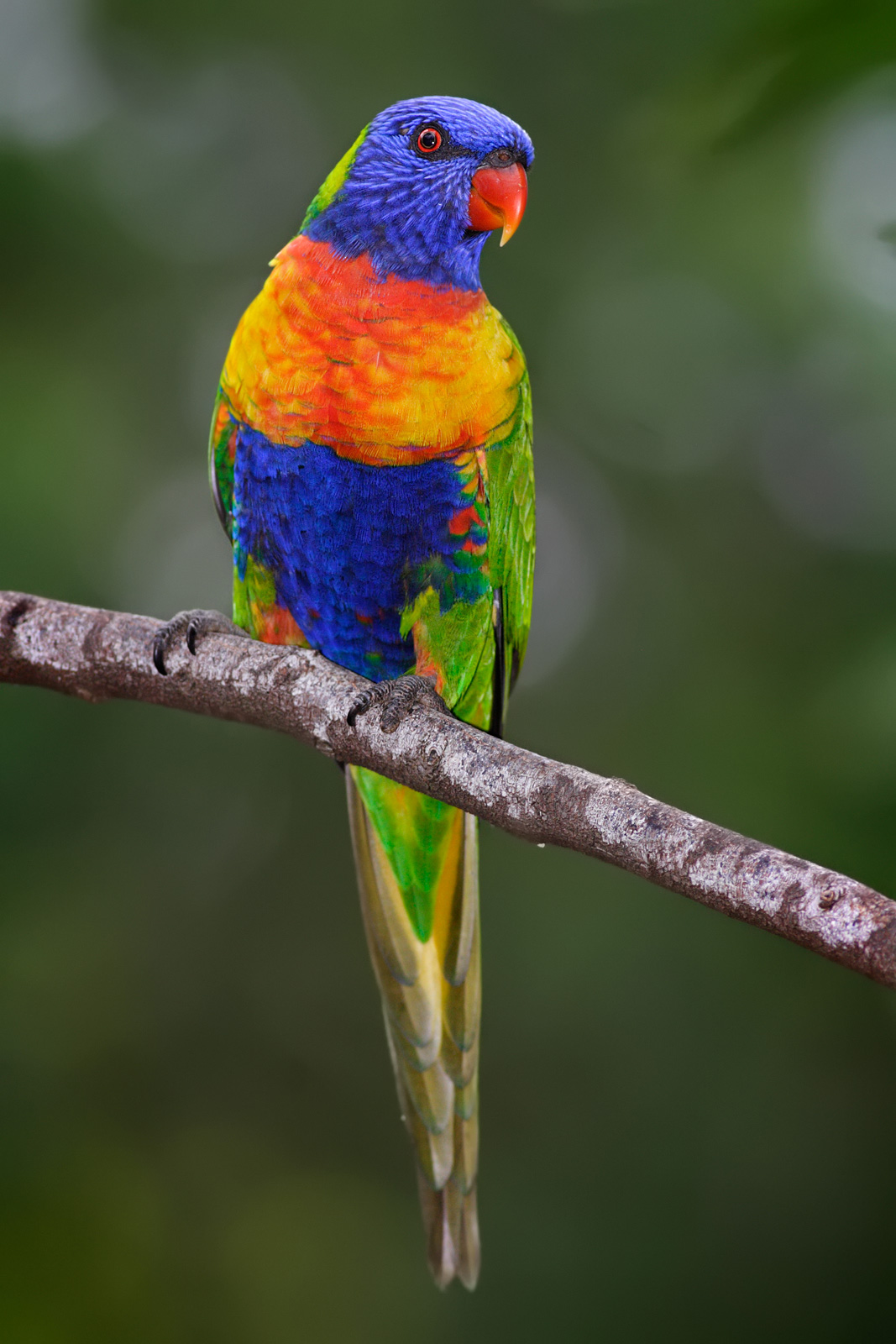
A Rainbow Lorikeet unafflicted by Lorikeet Paralysis Syndrome

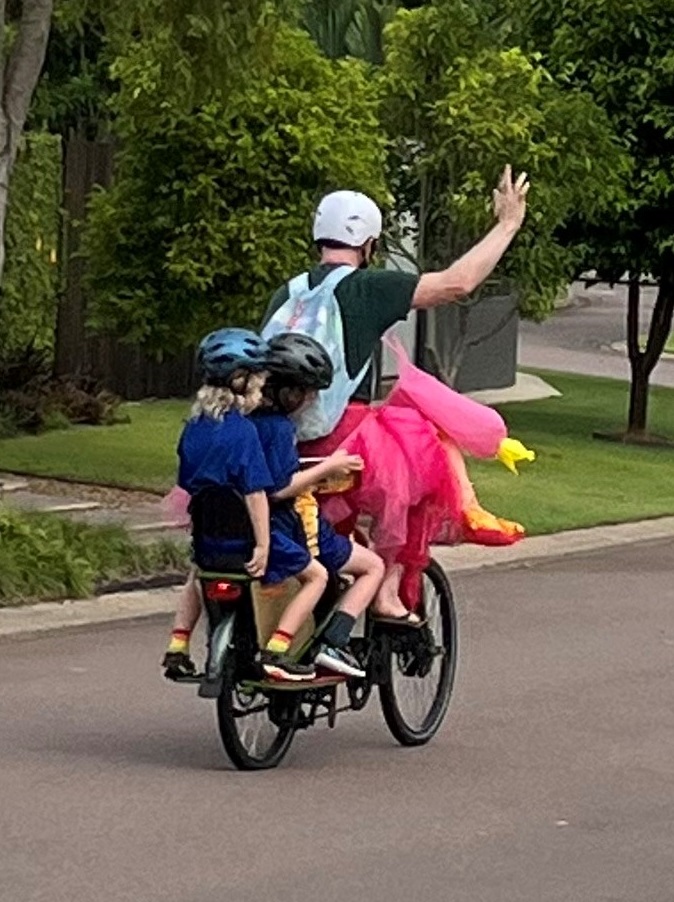
Farewell Kevin – the swinging icon.

Farewell Kevin – the swinging icon.

With some significant support from Kevin, we have made it to the end of school year 2023. Our first in Darwin, and a highly successful affair.

The ever-shifting sands that make up the ‘flamingo school pact’ meant that Kevin was worn every day for the first week of terms 1, 2, 3, 4 AND the final week of the year. By the end he was droopy and hagged. A slow leak or two, and a significant reduction in the power of his air intake fan, meant that his proud tail-feathers sagged and his elegant neck drooped. But he forged on right up until the final school bell, with his weird little crown still sitting atop that drooping head, and his pink tulle skirt still catching on my bicycle chain.

The boys have decided that Kevin will be retired for 2024, to be replaced by a giant, rideable prawn called Bob. Stay tuned in early 2024 for more news on Bob.

Kevin’s retirement may be for the best given I recently discovered (from a learned friend) that the flamingo is a well-known ‘secret symbol’ for swingers. That is, one should discretely display a flamingo if one is swing-curious – perhaps as a motif on a sock, or a handkerchief or even a small lower back tattoo if one is particularly committed. Other swingers in the know may then presumably recognise the subtle hint and thus find a way to discretely expose to you their own flamingo tattoo on that flabby bit of their upper arm. One can only imagine this might fast-track the small talk and expedite the swinging. In the absence of such shortcuts I am not sure how any conversation could ever be steered with any sort of efficiency to “do you and your partner ever have casual sex with other parent-aged couples in the neighbourhood?”, but perhaps I am just not a good enough conversationalist.

Now, I must say the flamingo theory is unconfirmed, and I noticed exactly zero people discretely exposing their flabby upper arm bits to me all year, but I wasn’t really looking. It is possible however, that Kevin has caused year-long confusion to the entire local swinging community and it will be a great relief to many that he has now retired to the wardrobe. I will research prawn symbology before Bob begins his career in a few weeks time.

A few notable milestones to quickly list for posterity:

  • The boys have learned many new, exciting and highly questionable words in their new school. One afternoon around mid-year they both came home energized and excitedly told us they know there is a ‘C’ word but they don’t yet know what that ‘C” word is. A friend subsequently told us she had learned from her son what the ‘C’ word is, but it is not the ‘C’ word we think it is. The mystery continues.
  • Monty learned to read and now delightfully reads out loud whenever he gets the opportunity, doing all the voices and intonations. Listening to him read a Dog Man out loud to himself is one of life’s great joys.
  • Milo won $40 in a local chess tournament, his first ‘earned’ money. It immediately opened his eyes to the power of capitalism.
  • Neither boy has had a haircut in more than 12 months. Neither has any affection for the hairbrush. This is a bad combination in the tropics.
  • The boys were showered with green slips throughout the year for various achievements; some real, some spurious. Milo received the family’s only orange slip for the year which seemingly was delivered to him by a relief teacher for writing too much on a ‘creative piece’ (his book was full and he wouldn’t stop). This seems like the orange slip equivalent of the ‘my weakness is I work too hard’ interview answer, so we have confidence his academic career remains on track.
  • The boys attended their first disco. Milo lay on the stage and read his book, Monty stood RIGHT in front of the speakers and danced alone for most of it. Later he told me in a fevered voice “I could feel the music inside my stomach!”
  • Monty joined the Eco-Warriors and thus spent one recess per week weeding the school veggie garden. We presume the roles become more glamorous as one climbs the Eco-Warriors hierarchy.
  • Milo spent the first half of the year playing chess in the library at lunch time, but unfortunately his challengers started dropping off. He recounted one particular game which sounded like the primary school chess equivalent of that scene in Troy – Achilles Vs Boagrius in which Brad Pitt Achilles is late for the battle and a small boy and crowd go to fetch him. A group of 3rd graders had gathered outside Milo’s classroom, returned from the library, just before lunch. They whispered excitedly among themselves; the 6th grade Boagrius of chess had challenged him and was waiting in the library. Milo strolled the 40 or so steps to the library, flanked by a posse of chess-curious 8 year olds. According to Milo, what followed was a very pleasant match, played in good spirits, in which Milo was the ultimate winner after a good 15 minute period in the middle where the game was, as they say, very much in the balance.
  • Both have perfected their cannonballs.

What joy, revelry and new rude words will Bob and 2024 bring us? We shall have to wait and see.

Test Match – The only board game that has NEVER been finished

Test Match – The only board game that has NEVER been finished

Although they share some of the same esoteric idiosyncrasies – monotony, inane tradition, confusing timeframes – I am not talking about real-life Test Match cricket, the pseudo-sport played by slightly out of shape men and women, walking back and forth and back again without purpose for hours and days at a time, I am talking about the boardgame of the same name; ‘Test Match’ – The Authentic All Action Cricket Game! invented by Crown & Andrews in 1977 and a summer mainstay of beach houses, caravans and rumpus rooms in Australia for over 40 years.

If you grew up in Australia it’s pretty likely you had a copy on your shelf, or your cousin did, or your dad’s mate whom you visited on Boxing Day for some reason. It holds a nostalgic association with summer time, and sandy feet, and long hot evenings, and water slides and left over ham in a pillow case.

But unfortunately, like many things that live and glow in that nostalgic little corner of our brains, like the coloured nose on a Bubble O’ Bill… it’s just a bit shit.

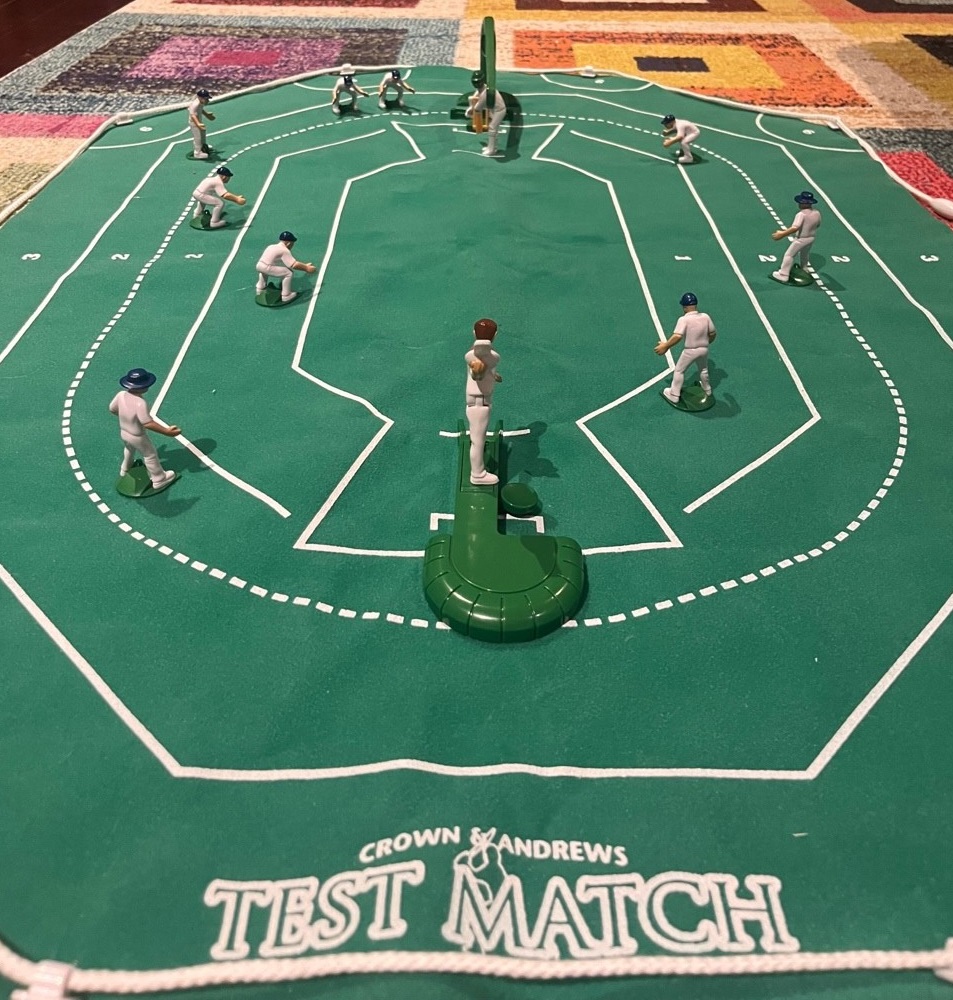
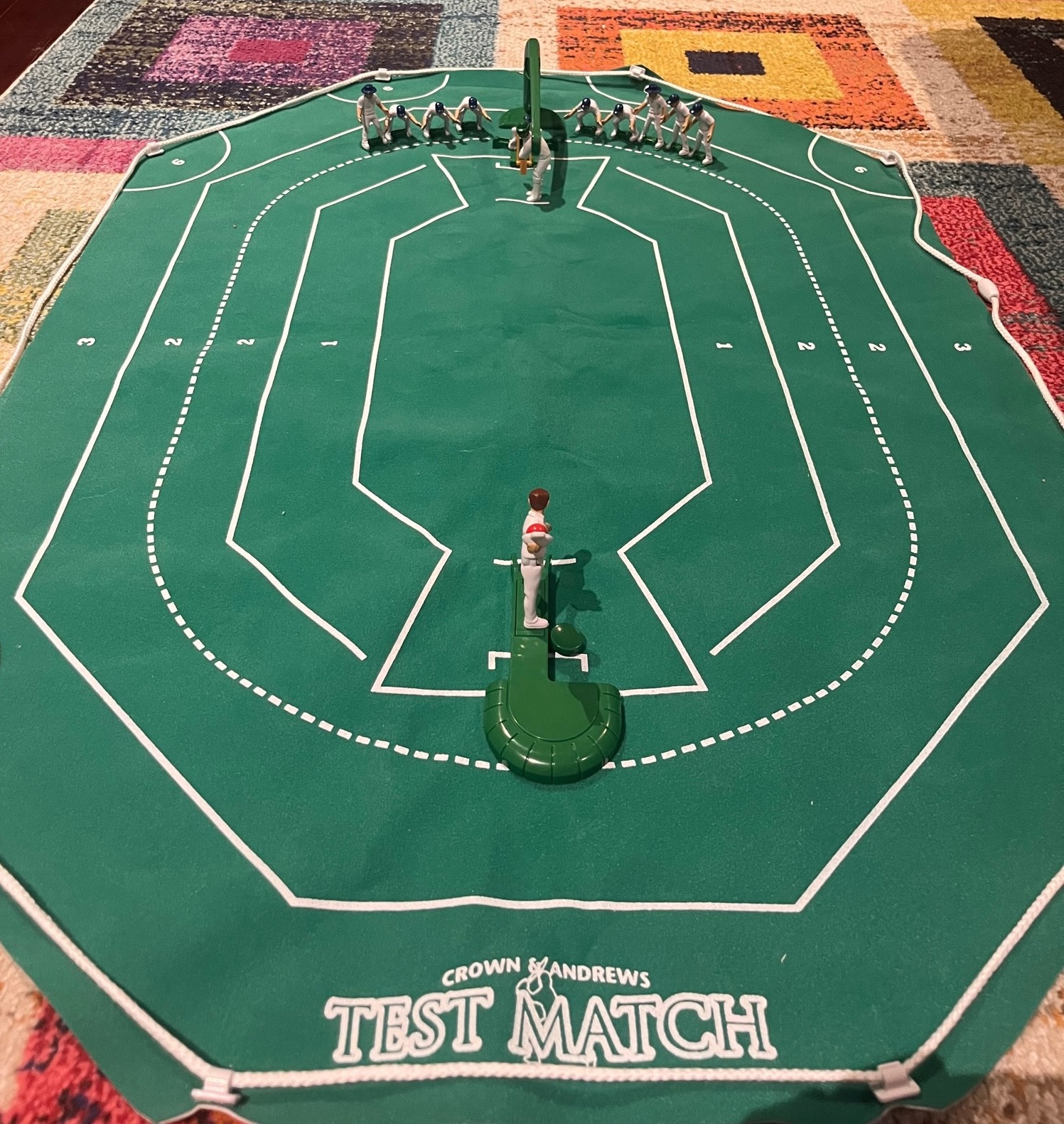
Essentially, you roll out this mini cricket oval made of green felt, about the size of a small coffee table then arrange little plastic fielders around it. There is a batter attached to a long plastic arm and an elbowless bowler, spring-loaded at his waist who hurls beamers or grubbers, but nothing in between.

This is a quote from the official rule book: “When you first take the playing pitch out of the box it will have some creasing from where it has been folded. If you lay the pitch on a flat table, smooth it out and leave if for a while, the pitch will flatten out. You can also give it a gentle iron.”

That is a lie.

30 years after you first unboxed this game the green felt will continue to undulate dramatically; hillocks, ravines, impenetrable chasms. If you try to pull one section flat another will bend and twist upwards. And if you ever try to iron that flammable green felt, even ‘gently’, it will catch on fire immediately. No, a lumpy, completely unpredictable playing surface is a timeless and unavoidable element of this game.

The rules boast that the game can be played by 2-24 players. By this they presumably mean that one could assemble 21 of one’s best friends or cousins and form two teams of 11. Each person would presumably then sit patiently, watching the riveting action unfold, while waiting for their turn to bat or bowl. The rules even suggest the poor suckers who arrive number 23 and 24 could fill the coveted roles of umpire and square leg umpire. Taken together, these are the worst ideas any boardgame manufacturer has ever had.

Crown & Andrews also obliquely claims that one can ‘PLAY ALL FORMS OF THE GAME’. It’s not completely clear what is meant by that half-sentence, but notably the manufacturers remain silent on the far more salient question – which is should one play any form of the game. The answer to that question is obviously no, which every person who has ever played Test Match Cricket discovers in about 8 minutes.

And so the game begins, with much misplaced excitement and hope.

This is how the field generally looks in preparation for the first over.

Sensible field, offering good support to the bowler but not overly aggressive – designed to entice stroke-making.

Now, deliveries don’t take long to bowl in Test Match Cricket so it takes a little more than an over to make a drastic fielding change, but never any more than three. It takes about 18 deliveries to realise it is extremely difficult for the batter to get the ball in front of square, and completely impossible unless they are prepared to bravely meet a full toss with their face.

In the 40 year history of this game being played, a batter has successfully struck a drive off the bat in front of square on exactly fifty-nine occasions. Of those fifty-nine, the ball has been directed into that tiny little catching pouch between the fielder’s legs seven times. On each of those seven serendipitous occasions the miniscule force of that tiny little red ball has immediately flung the fielder to the ground, and the ball has then rolled gently for two. I am quite confident in my assertion that nobody in the history of Test Match cricket has ever been caught out in front of square.

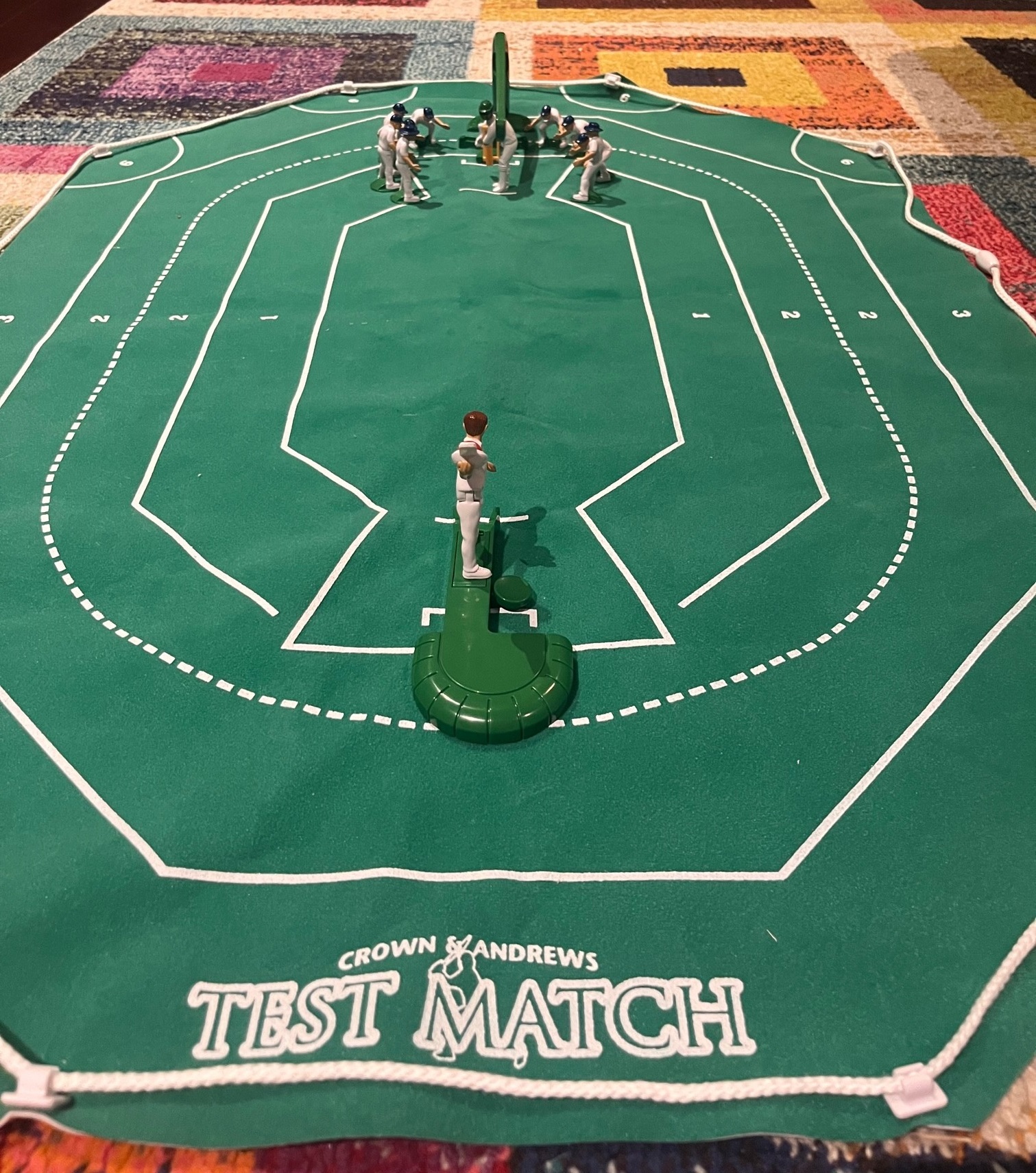
So, this is what the field looks like after three overs.

A few catches are taken by those crouching down guys over the next three overs, but most deliveries go for 4 leg byes. And boredom is setting in.

This is how the field looks after another three overs.

This setup probably only lasts another 4 or 5 deliveries, and by now the scorecard looks like this.

3/134 after 9.5 overs. Ten runs taken off the bat. 124 total sundries including a whopping 76 combined byes and leg byes.

There is only one more step here before the game is completely abandoned, and that is to see how many of the crouching down guys can be knocked over in a row by paddling their bums (5 is the most, but 1 is the most fun).

And that’s it, the entire game. Absolute proof that the Crown & Andrews boardgame Test Match Cricket has never been completed in its 40 year history. And perhaps proof that games don’t really need an objective or purpose, much like the real life ‘sport’ from which this game drew its inspiration.

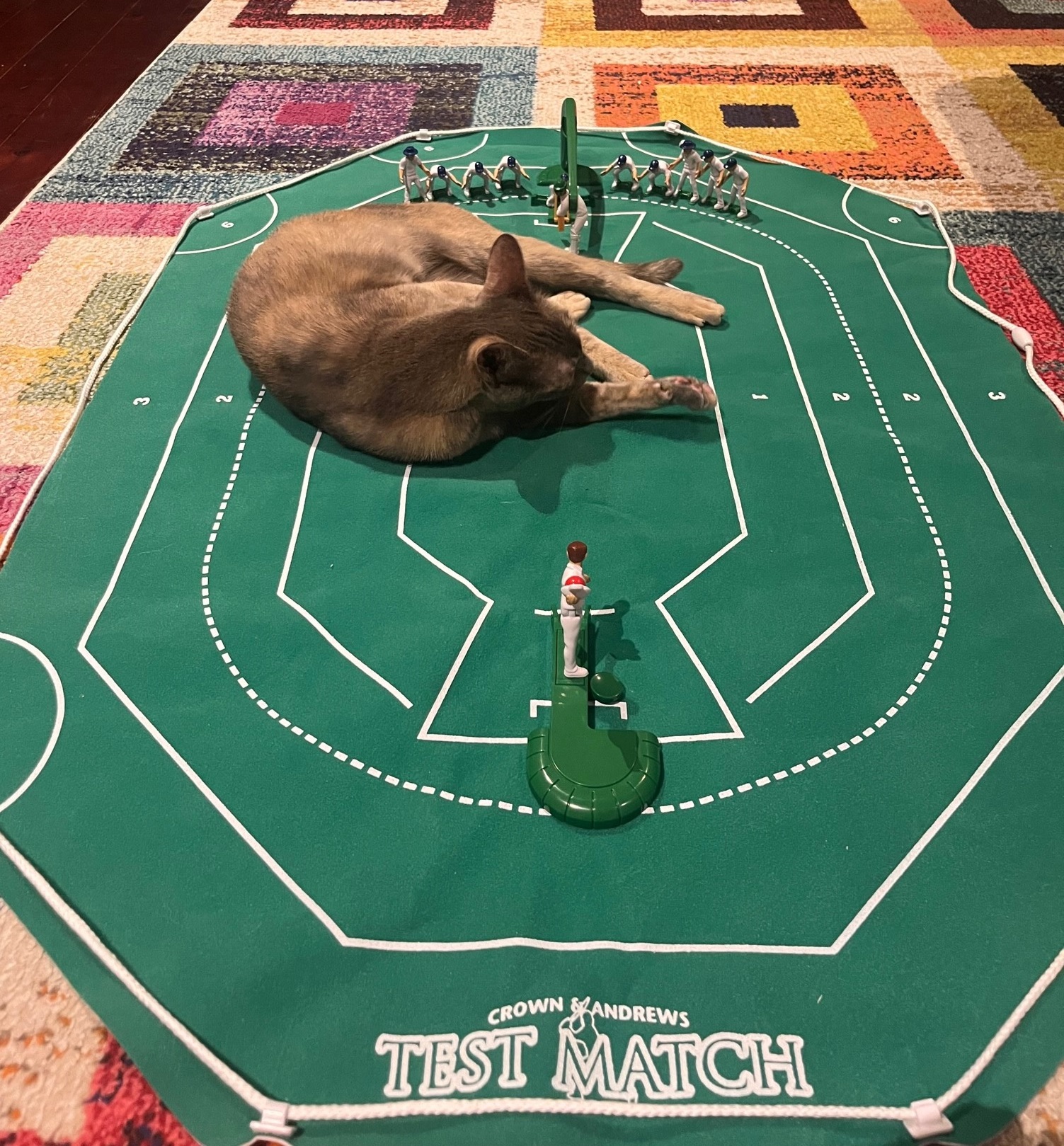
An abandoned pitch is a fine place for a lucky cat to groom herself.

Catan Junior – The Goat Method

Catan Junior – The Goat Method

Those unfamiliar with the cult boardgame Settlers of Catan, invented by a German dentist in the mid-90s, or the child-a-fied version Catan Junior described as ‘A Catan adventure for fledgling swashbucklers’, will likely find this blog post quizzical, bewildering and not really very amusing. Those people may wish to stop reading now and return to the rest of the internet. I would not be at all upset.

For those still with me I will provide a quick re-cap. Catan Junior is a simple trading game, played across a board that can be completed, in the company of normal children, in about 20 minutes. Each player takes on the role of some kind of benevolent pirate; not the violent, reprehensible kind, but a middle-class sort of pirate, just trying to make his or her way in the world by building lairs and boats and yet more lairs, in order to take over a nice looking archipelago with a rather ominous looking skull island in the middle, which seems to have no bearing on anything.

In order to build these lairs and boats and lairs, one needs to collect and trade a variety of resources, namely; gold, timber, cutlasses (which isn’t really a resource), molasses and goats. It’s a weird sort of resource selection, but fine. One collects and trades these items in a variety of ways that I can’t really describe to you adequately nor remember; but basically a boat costs, let’s say, two goats, a cutlass and a barrel of molasses for some reason, so you try your best to get those resources and then trade them in for the boat. Great.

A key feature of the game is of course each resource is finite, which is inconsequential so long as they keep cycling around in the ultimate pursuit of lairs and boats and lairs. Everybody has a tremendous time. You get the picture.

It’s actually a pretty inoffensive game; one that can be played whilst reading a book, or stretching or practising the guitar, and we have played it many times without incident. That is, of course, until two weeks ago when Monty declared from now on he would only be collecting goats…

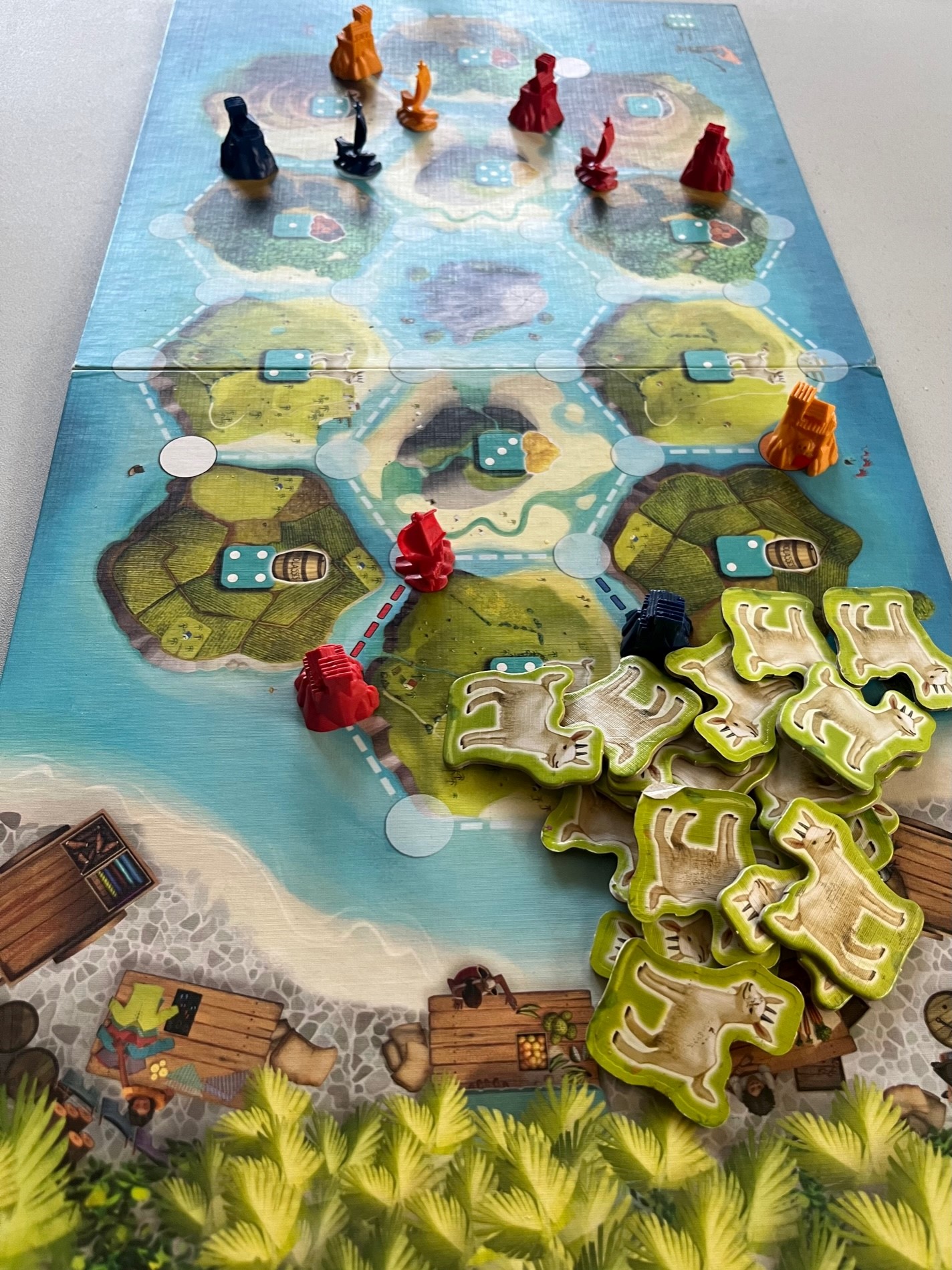
Milo and I giggled at Monty’s proclamation but really thought nothing of it until he really started stockpiling goats. Any time he got to place that little plastic guy on a resource so you’d get double of whatever, he’d choose goat. On every turn he would relentlessly trade in two of whatever he had for more goats (because you can do that – two molasses equals one goat, if you are that way inclined). Never seeking a lair or a boat or a lair. Just goats goats goats.

Milo, always with both eyes fixedly held on the championship trophy (in all things, all the time), noticed it first. He and I both needed five lairs for victory, and there is a significant goat overhead for each. The surplus goat pile was still large, but dwindling, and no longer sustainable. Goats were suddenly a rare and valuable resource. Milo joined the great goat pursuit.

Trading, dealing, cajoling for any spare goats, offering ludicrous sums for those that remained. Five, 6, 7 bags of gold for a goat was not an unheard of price at the peak of the frenzy. Of course I took these riches, liquidating my goat supplies, blinded by the shiny ore that has bewitched men and women alike for millennia. I drowned in it, my hubris, and with no ability to build boat nor lair, was left trapped in a far-flung corner of the archipelago, like some sort of nautical Midas; regretful, alone and goatless.

Meanwhile, closer to the isthmus water market at the eastern end of the island chain, the goat wars raged on. Milo desperately seized every goat he could negotiate, stockpiling against future requirements. But Milo was doomed, and he knew it. Try as he might, Milo could not shake his overpowering instinct to follow the rules and triumph. Monty, untethered from such impulses, moved relentlessly towards his solitary goal. Goats.

Every time Milo released a goat, in a calculated move to secure some wood, or a boat, or a Coco the Parrot card, Monty would calmly procure it and toss it into his haphazard pile. Milo balled up his fists in frustration, calculated, re-calculated, and offered yet more molasses to Monty for a goat. Please just one more goat!

But Monty was unmoved. Soon the last goat was procured and lobbed uncaringly into his seething, writhing tower of goats, and the game came to an end. Monty walked off to do something else.

Milo rested his chin in both hands, looked ruefully at me, then, shaking his head, glared over at his brother who had already disappeared down the corridor.

Milo looked over at me once more, smiled, and said warmly “that was pretty funny.”

Later that night, as he slept, Milo’s brain processed the interaction between resource scarcity and value, and wondered if the market can really lay the platform for universal prosperity in a world of irrational actors, like his goat-hoarding brother.

Goats

A sex bike has six wheels

A sex bike has six wheels

This afternoon we explained sex to Milo and Monty. The way the subject came up is one of the most Milo things that has ever happened.

At school today one of his class-mates was delivering a ‘persuasive argument’ as to why a motorbike is better than a quad bike. The conversation progressed naturally among the class until one of his friends offered, by way of support for the counter argument, that she had previously ridden on a quad bike and it was great, although the bike she had ridden had six wheels, not four.

Milo, never able to abide inaccuracy or a missed opportunity to demonstrate knowledge, put up his hand and said technically its six wheels would make it a ‘sex bike’, not a quad bike. Much hilarity ensued. Milo knew he had said something amusing, and so laughed along, but it was not at all clear to him what he was laughing about. Of course upon arriving home he sought clarification from his parents, and here we are.

It is so obvious in hindsight that the numerical prefix for 6 was always going to be the way our eldest child was introduced to sex.

Of course it was.

A Sex Bike

#becausedarwin

#becausedarwin

Quickly we have learned there are many questions in this place for which there is only one answer.

“Why is there a giant black beetle riding a green tree frog on our driveway?” #becausedarwin

“Why is there a python dangling from our front porch eating some kind of lizard?” #becausedarwin

“Woah, why did we get home so quickly?” #becausedarwin

“Why does that restaurant sell laksa pizza?” #becausedarwin

“Why don’t I groom anymore?” #becausedarwin

“Why am I sweating under water?” #becausedarwin

“Why does my lemonade taste like mosquito?” #becausedarwin

“Why does that guy whose name appears to be Dan have his first name ‘Dan’ as his numberplate? Why does he need that? Doesn’t he know his name is Dan already? Why do I need to know his name is Dan?” #becausedarwin

“Why am I wearing a tie-dyed shirt at work on a Tuesday with three buttons undone?” #becausedarwin

It has become a common refrain in our home and the boys enjoy its use a great deal; “Milo, why haven’t you brushed your teeth?” … because Darwin dad.

THE LOLLYPOP GUY

I feel there is likely to be a whole series of these, as the weird becomes the norm… but I’ll start with this one, which is our best example of the genre to date.

On the last day of the Flamingo episode the school crossing lollypop guy asked me for a photograph. We had been engaging in fragmented conversation all week, but standing in the middle of a school crossing dressed as a flamingo is not the best locale for properly breaking the ice. I responded with general positivity about the concept of the photograph and hustled the boys forward, but by the time I returned he had gone, or I had removed Kevin, or a combination of the two.

The following week as I sat in a coffee shop not far from the school, the lollypop guy walked past and, somehow recognising me as Kevin’s chaperone, sat down. We chatted for a few minutes as I laid out the general ethos of Flamingo Parenting when, all of a sudden, I noticed a giant poster of his face sitting conveniently just over his shoulder about 20 metres away. It was framed perfectly. I did one of those non-sensical ‘point at picture, then point at person, then point at picture again’ routines, whilst looking baffled and intrigued.

“Oh yeah, I am the local member of Parliament” he said nonchalantly.

#becausedarwin

More to come.

Because in Darwin the Post Office workers are pretty confident they know everybody who visits by sight

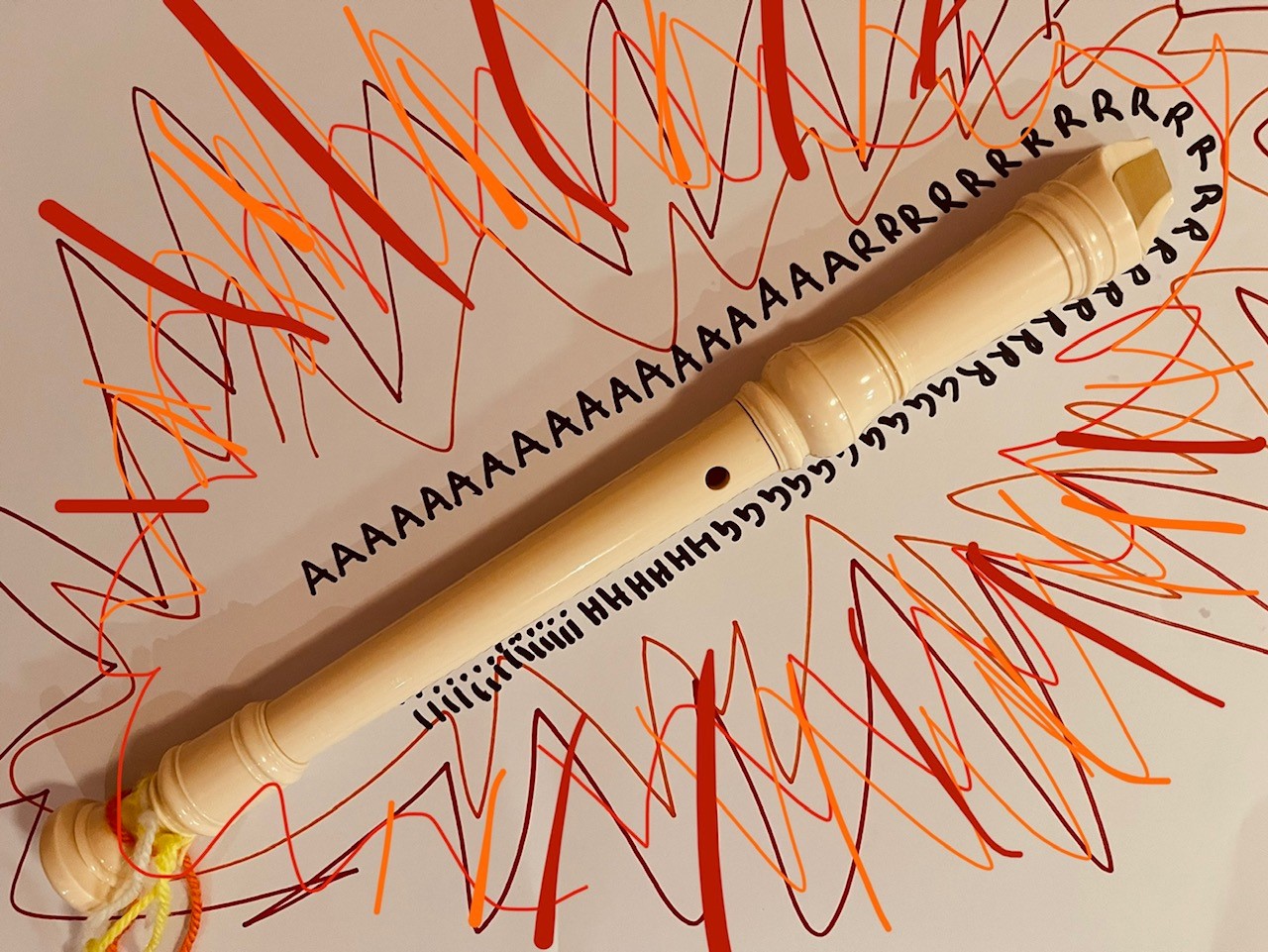
Recorder Hell

Recorder Hell

We are in recorder hell.

Two Fridays ago Milo came home with a recorder. A State-sanctioned, State-endorsed, State-sponsored recorder. We have to pay $7 for Happy Healthy Harold but recorders are deemed so essential they are prioritised in the budget and provided to all. I received a recorder in year 3, you received a recorder in year 3, we ALL received a recorder in year 3. Where did this intergenerational torture come from and why does it persist?

A recorder is a shit instrument in so many ways. Unless a child plans to host medieval banquets as an adult, mastering it gets them nowhere. It is so temperamental that if the applied pressure is off by half a hecto-pascal (I know this is a unit of pressure from a childhood spent watching local weather reports and presume it also the correct unit of measure for recorder playing) the sound moves quickly from accurate (but still pretty shit) to absolutely ear-splitting in a nano-second. Because it is so boring to play properly, every single practice session moves from Hot Cross Buns to ‘damage all those tiny important bones in my parents’ ears’ within 35 seconds. It is so transportable that I don’t even know it has come in the car with us until the sound is blasting those little wispy hairs that I only just discovered off my ear-lobes.

Also, why does every song sound the same? Hot Cross Buns? Mary Had a Little Lamb? Jingle Bells? On the recorder – same song.

One of the downsides of owning a record player is that the boys enjoy playing 33s at 45 speed and vice versa. One of their favourites is playing Taylor Swift 33s at 45, like a Taylor Chipmunk. They call her Saylor Sift and these days she features on the rotation more regularly than Taylor. Saylor is not bad actually, once you get used to her, and much much better than 45 Taylor played at 33 – Maylor Mift. She is melancholy and depressing, and makes you think bad things are just over the horizon. Anyway, recently Milo has started playing his recorder along to Saylor Sift. It is absolutely as awful as it sounds.

I do actually want some answers. I presume at some point an education department apparatchik forgot to carry the one and signed off on a vastly larger contract with ‘big recorder’ than they intended. And knowing, as we all know, that you don’t mess with ‘big recorder’ we are all still paying for this mistake.

Days, or at most weeks from now, all of these thousands of new recorders will mysteriously vanish, as so many millions have vanished before them. But in the meantime parents across the country are shaking their fists, covering their ears, and yelling frequently, and irrationally at their children who are gleefully shattering the peace all in the name of ‘music homework’.

An artistic impression of my recorder dreams

The three things I learnt full-time parenting for a year

The three things I learnt full-time parenting for a year

I went back to work this week after almost fourteen months full-time parenting our boys. After the initial shock of the bright lights and the typing and the chair that spun around and the buttons on the front of my t-shirt and the weird way my shorts seemed to go all the way down to my ankles… I started thinking about what, if anything, I could take away from the year.

I think I should not have been thinking about these things while I was being paid to type and spin and talk and type and spin. But I can’t be completely sure about that.

Here are the three things.

Know the names of the other kids in your child’s class

I stumbled onto this one by sitting in Milo’s class every Monday morning while the children read to me one by one, according to a list in a clipboard.

None of them made eye contact for the first week or two but pretty quickly they started calling me ‘Milo’s dad’ and asking me questions like; “Milo’s dad, why don’t you have any hair?”, “Milo’s dad, why aren’t you at work?”, “Milo’s dad, why aren’t you wearing any socks?”.

Because I had the official clipboard with all the names it was very easy for me to quickly learn who they all were and I could easily respond with their names; “Well Angela, because my father cursed me genetically”, “Ahmed, that’s because I’d rather be here hanging out with you”, “Milli, I am, but they are those really little ones that stay down inside your shoes. I think they look stylish.”

There was a big box that I sat next to containing books of all different genres and reading levels. Most of the kids would thumb through diligently to find the right coloured reader for their level, and to find a subject that interested them. In this way I quickly learned a little about what each of them was interested in. Oh, tadpoles? Oh, green pythons? Oh, Alex you like witches with metal teeth and bony legs? Cool.

This tiny bit of knowledge was useful on so many occasions with Milo throughout the year. It gave me material for follow-up questions when the standard first refrain of “how was your day?” was met with “good”… as it always is, and has been since the dawn of time, or shortly thereafter when children were invented. “I saw Jerome bouncing his handball after school. Did you guys play today?” etc etc. It didn’t always work of course, but assigning names to the conversation joggers definitely seemed to help.

It also helped when Milo was in and out of friendships, or sitting next to new people, or not invited to birthday parties, or carefully exploring with me whether it’s okay to break a promise to someone at school if that someone had made him promise not to tell anybody that the someone was planning to burn down the school (for example).

Of course I had the opportunity to sit in the class with a clipboard and repetition and conversation, which is not easy to replicate when your precious time is absorbed by paid employment. This is the blue-ribbon scenario and any opportunity to get inside the classroom should be seized; it lets you behind the curtain, you see how your children hold themselves in class, how they interact with their friends and their teacher, if they are comfortable and happy. It also gives you irreplaceable insight into the ordered chaos their teacher is dealing with.

But it occurs to me, if such an opportunity is not available to you (as it now may not be to me), this knowledge can still be won with some focused effort. I am not naturally good at it, but I am actively trying to listen and process and talk to all these new kids at drop-off and pick-up whenever I can, and ask the boys about their new classmates each day. I think it is worth the effort.

One of Monty’s new friends told me today her grandma is planning to dress up as a flamingo next term. I hope this to be true.

You will probably feel you wasted the opportunity

I did. I felt like I blew it.

How few tree houses we built, how irregularly we rambled aimlessly up mountains, how absent from our bookshelves are any original comic books sketched together, how short the list of art galleries we visited on a whim. How many potentially interesting conversations did I shut down because I was tired or distracted? How many games of chess and Yahtzee did I decline? How many times did I say no to the playground or tree-climbing after school because I wanted to go home? It can keep you up at night if you let it.

But don’t let it.

When we asked the boys to name the highlight of the year they both said ‘ice cream and library on a Tuesday’. This was one of our routines. Every Tuesday after school we would ride our bikes first to the local Sri Chimnoy café for ice cream and enlightenment, and then onto the library at which time we would clean them out of any books related to Minecraft, terrarium building or wetland bird migrations.

This year has confirmed for me that children do not care about pretty views, and they have very little regard for grand gestures. They love routines, traditions, predictability and spiritual ice cream. And actually, when we allow ourselves to accept it, that’s what adults love too.

Most likely you still won’t know what you want to do when you grow up, but you’ll be more okay about that

It is tempting to think that any extended time away from one’s usual routine will yield insights on important matters such as; purpose, direction, employment, health, hobbies, ‘beard or no beard’. Very little of this happened for me. I made no substantial career change, I cannot play the lute, I have no new tattoos, I hold no high scores at the arcade, I am now clean shaven but not deeply committed to it.

But… I am more comfortable with the uncertain soup of life than I have ever been.

My hopes and ambitions remain, but the energy is different. I am not completely sure why. But I think watching your children everyday learn to read, and chop vegetables, and ride bikes (or not as the case may be), and do lay-ups, and perform the Budapest Gambit, and write numbers with chalk, and dye their hair pink, and sometimes be kind to each other, and make smoothies, and tell jokes, and tie their shoe laces, and master card games, and do cannon balls, and play records, and sometimes do thoughtful and considerate things, and identify lizards correctly and juice lemons… delivers a calmness and perspective to your life.

These boys sit at the core of our family and my life, and I have spent a year confirming that every day. So perhaps life decisions made in the second or third ring, although important, seem less consequential than they once did. I think it’s something like that.

Or perhaps I am just misunderstanding the critical importance of the typing and spinning and talking and typing and spinning. Or perhaps I am just not doing it right…

Shoes well worn


Flamingo Politics

Flamingo Politics

No, I did not expect my first four posts of 2023 to start with the word flamingo. I’m as surprised as anyone.

Milo’s class chose their representative to the school council this week. Interested students needed to prepare a one minute speech supporting their candidacy, and deliver it to the class just before recess. To my surprise and delight Milo enthusiastically said he would like to have a go and so hand-wrote himself a short speech which he drafted and redrafted until he was happy with the tone and content. Given this was his first ever speech we practised it five or six times so he could get the timing of his jokes just right, and so he could make sure he could read his own hand-writing at the critical moment. He also wrote “SLOW DOWN” in big letters at the top to remind himself to take his time. The whole process was about as adorable as it gets.

Milo’s pitch had two prongs.

The first was to begin a campaign to change the awful school bell/ music. This needs some explanation. At the boys’ new school there is no bell. Instead there is a rather strange musical mash-up (which must impinge upon multiple copyrights) which they pump through the tinny, mono speakers for about 10 minutes before the school day begins. Most of it is indecipherable but through the haze one can recognise Frozen, Pachelbel’s Canon in D, possibly bits of Tim Minchin’s musical Matilda and maybe (at least subliminally) a hint of Crazy Frog. It is weird to say the least, and somewhat eerie. It feels like the music that might be played inside a bomb shelter, through the air-raid speakers, at the end of the world.

Prong number 2 was an undertaking, via his inside connection, to bring Kevin the Flamingo back in term 2.

These two big campaign promises, I think, demonstrate a better understanding of the electorate’s wants and needs than either major political party in Australia. And the fact that Milo has already secured agreement on the second promise shows a political nous beyond his years.

So I dropped the boys off at school, wished Milo good luck and went for a coffee to settle my nerves. Whilst sipping my coffee I was greeted by the school crossing guy who requested a photograph of Kevin last week. He sat for a few minutes and we chatted. As it turns out he is our local member of Parliament (#becausedarwin). He asked a few more questions about Kevin and I told him about Milo’s speech. He was impressed and I could tell he was considering how Kevin (or Milo) might be able to help him in future campaigns.

At pickup it was clear right away that Milo had not been voted in by his peers. He said the speech had gone well, that he had enjoyed it, but that it hadn’t worked out. He seemed disappointed but not crushed. I felt terrible for him and said all sorts of things at once; I’m so proud of you for even trying in your second week, It’s hard because many of them might not know your name yet, Don’t worry there’ll be so many more opportunities in future, Did I mention I am proud of you? He eventually gave me the ‘shoosh dad’ face and said he was okay. He then said perhaps we need to stay in Darwin a few more years so he can have another go.

All of this got me thinking about how easy it is to dispense advice to our children, and how not so easy it is to live by that advice ourselves. I do it all the time.

Well, I actually wrote a picture book quite some time ago, based on this blog, which tells the story of a dad who spends six months at home with his first son. He is apprehensive at first but he figures out a few tricks and ends up having the time of his life. My very talented friend and parenting co-conspirator Alex has been illustrating it, but for some reason I have really been dragging my heels about doing anything with it, for years. Fear of failure is, I am sure, a big part of it.

But I think if my 8 year old can stand up in front of 20 mostly-strangers in his second week and promise them new school music and a plastic inflatable flamingo named Kevin then I, as a fully grown adult human, can muster the courage to send a manuscript to a few publishers.

Stand by.