
Those unfamiliar with the cult boardgame Settlers of Catan, invented by a German dentist in the mid-90s, or the child-a-fied version Catan Junior described as ‘A Catan adventure for fledgling swashbucklers’, will likely find this blog post quizzical, bewildering and not really very amusing. Those people may wish to stop reading now and return to the rest of the internet. I would not be at all upset.
For those still with me I will provide a quick re-cap. Catan Junior is a simple trading game, played across a board that can be completed, in the company of normal children, in about 20 minutes. Each player takes on the role of some kind of benevolent pirate; not the violent, reprehensible kind, but a middle-class sort of pirate, just trying to make his or her way in the world by building lairs and boats and yet more lairs, in order to take over a nice looking archipelago with a rather ominous looking skull island in the middle, which seems to have no bearing on anything.
In order to build these lairs and boats and lairs, one needs to collect and trade a variety of resources, namely; gold, timber, cutlasses (which isn’t really a resource), molasses and goats. It’s a weird sort of resource selection, but fine. One collects and trades these items in a variety of ways that I can’t really describe to you adequately nor remember; but basically a boat costs, let’s say, two goats, a cutlass and a barrel of molasses for some reason, so you try your best to get those resources and then trade them in for the boat. Great.
A key feature of the game is of course each resource is finite, which is inconsequential so long as they keep cycling around in the ultimate pursuit of lairs and boats and lairs. Everybody has a tremendous time. You get the picture.
It’s actually a pretty inoffensive game; one that can be played whilst reading a book, or stretching or practising the guitar, and we have played it many times without incident. That is, of course, until two weeks ago when Monty declared from now on he would only be collecting goats…
Milo and I giggled at Monty’s proclamation but really thought nothing of it until he really started stockpiling goats. Any time he got to place that little plastic guy on a resource so you’d get double of whatever, he’d choose goat. On every turn he would relentlessly trade in two of whatever he had for more goats (because you can do that – two molasses equals one goat, if you are that way inclined). Never seeking a lair or a boat or a lair. Just goats goats goats.
Milo, always with both eyes fixedly held on the championship trophy (in all things, all the time), noticed it first. He and I both needed five lairs for victory, and there is a significant goat overhead for each. The surplus goat pile was still large, but dwindling, and no longer sustainable. Goats were suddenly a rare and valuable resource. Milo joined the great goat pursuit.
Trading, dealing, cajoling for any spare goats, offering ludicrous sums for those that remained. Five, 6, 7 bags of gold for a goat was not an unheard of price at the peak of the frenzy. Of course I took these riches, liquidating my goat supplies, blinded by the shiny ore that has bewitched men and women alike for millennia. I drowned in it, my hubris, and with no ability to build boat nor lair, was left trapped in a far-flung corner of the archipelago, like some sort of nautical Midas; regretful, alone and goatless.
Meanwhile, closer to the isthmus water market at the eastern end of the island chain, the goat wars raged on. Milo desperately seized every goat he could negotiate, stockpiling against future requirements. But Milo was doomed, and he knew it. Try as he might, Milo could not shake his overpowering instinct to follow the rules and triumph. Monty, untethered from such impulses, moved relentlessly towards his solitary goal. Goats.
Every time Milo released a goat, in a calculated move to secure some wood, or a boat, or a Coco the Parrot card, Monty would calmly procure it and toss it into his haphazard pile. Milo balled up his fists in frustration, calculated, re-calculated, and offered yet more molasses to Monty for a goat. Please just one more goat!
But Monty was unmoved. Soon the last goat was procured and lobbed uncaringly into his seething, writhing tower of goats, and the game came to an end. Monty walked off to do something else.
Milo rested his chin in both hands, looked ruefully at me, then, shaking his head, glared over at his brother who had already disappeared down the corridor.
Milo looked over at me once more, smiled, and said warmly “that was pretty funny.”
Later that night, as he slept, Milo’s brain processed the interaction between resource scarcity and value, and wondered if the market can really lay the platform for universal prosperity in a world of irrational actors, like his goat-hoarding brother.
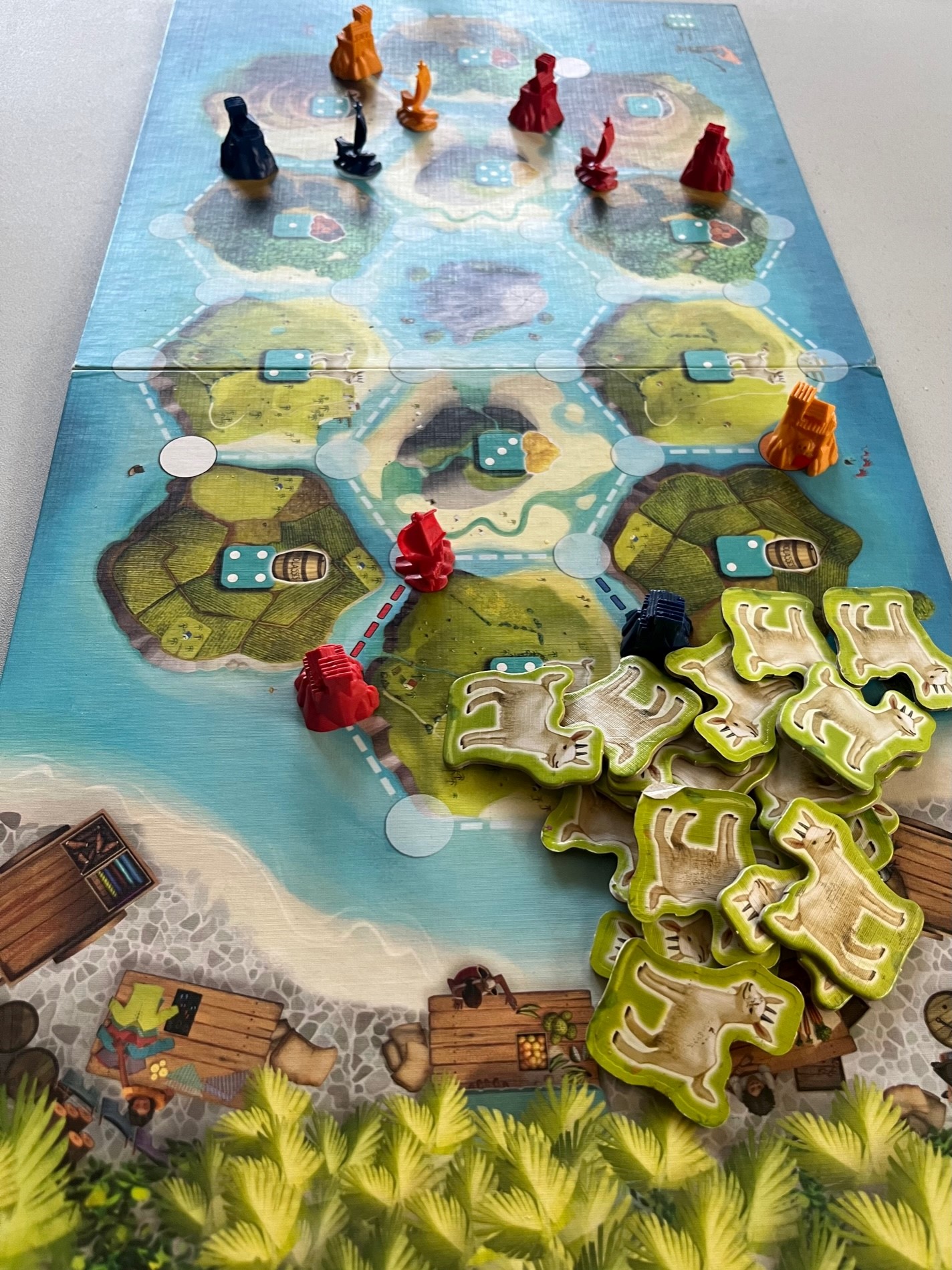
Goats






 Jupiter & Sons